Book publishing in 2026 is not a hassle anymore. Yet, it gets so overwhelming that many authors give up in the middle of the journey. Let’s be honest, we all get hyped up and excited with the thought of publishing a book. We tell our relatives, friends, and family, and decades later our book remains unfinished. Even if you have successfully published a book, I can bet there would still be so many unfinished books, begging for your attention.
Why does this happen? Well, it is usually due to disregarding the cost of publishing a book. Wondering about the cost, you may have searched online, and you may also have ended up getting vague answers. Too vague and cheap that it becomes utterly impossible to trust, too expensive that the thought of professionally publishing a book feels out of reach.
The truth is that the cost to publish a book entirely depends on several factors. These are the factors we unintentionally ignore. Publishing a book professionally is like adding sugar according to your taste. The more sugar, the sweeter and more sugary the product will be. By that I mean what your manuscript requires, how you want your book to look, or which publishing route you want to choose.
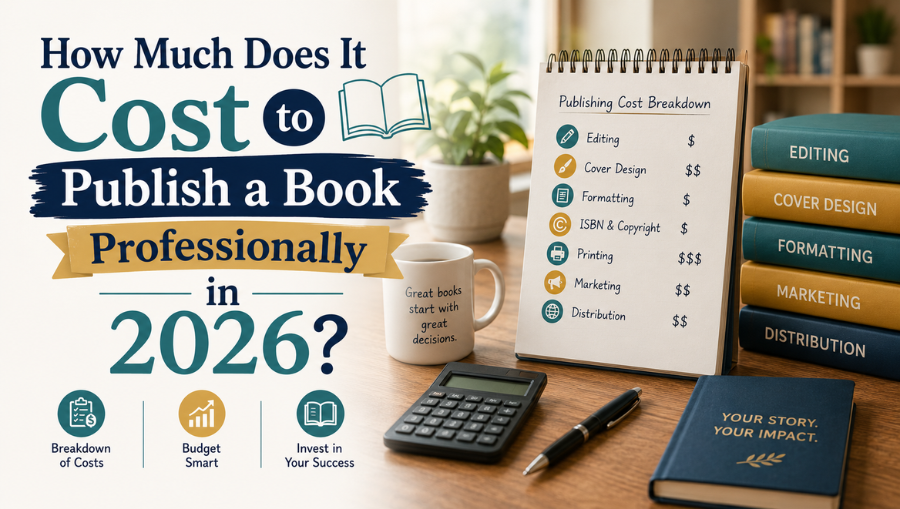
This guide is all about breaking down the main costs behind professional book publishing, including editing, cover design, formatting, printing, distribution, publishing, marketing and more. You’ll also learn where you can cut corners and how you can avoid overspending, and how you can plan a realistic publishing budget without feeling pressured or rushed.
Why Publishing Costs Feel So Confusing in 2026
Your question on how much it costs to publish a book does not have a single answer. It happens due to the level of services, support and professional expertise you are hiring.
A small children’s eBook with only cover creation and light proofreading will not cost as much as a 300-pages full length fiction novel with developmental editing, professional formatting and custom cover designing and illustrations. Likewise, a memoir that is written only for close family members will not ask you to invest thousands of dollars as compared to a business book that builds your credibility. Nonetheless, it is a place where first-time authors get stuck.
This is where many first-time authors get stuck. They often think that publishing is one thing rather than a set of different expertise and services.
So, before asking how much cost to publish a book, ask what kind of publishing experience you want. By experience, I mean how you want your audience to feel when they hold your book and read it. This question changes everything.
Does It Cost Money to Publish a Book?
This is tricky. It may cost you nothing, and it can also cost you thousands of dollars. It depends on which path you want to take.
Technically, if you are choosing a self-publishing platform and take the DIY approach, then you can upload your eBook or print book file for free.
On the other hand, professional publishing means investing in book cover designing, formatting, editing, publishing and more. This means whatever you decide to do with your book professionally increases the cost. For example, some work with a publishing company that manages the entire process, while others hire freelancers for each of the required services. There is no shame or indignity in either of the routes.
The Main Factors That Affect the Cost to Publish a Book
Let’s look at some of the factors that affect the cost to publish a book online or in print.
1: Book Length and Word Count
Word count has a direct correlation with the production stage. Editors need more time to edit a 100,000-word novel, as compared to 20,000 short story. Similarly, proofreaders need more time. Formatters may need to manage more chapters, pages, references, headings, images, or design elements. Printing may also cost more because longer books require more paper and more production work.
This is why a short devotional, a children’s book, a full-length novel, a memoir, and a business book can all have very different publishing costs.
2: Genre and Book Type
Most of the people don’t realize this, but genre matters a lot. If you’re working on a novel, then you need to pay more attention to the pacing, character development, flow, and story continuity. A memoir would require you to work on sensitive matters, structure and the tone. The same goes for a business book that would require you to edit for clarity, authority and credibility, and so on and forth. The truth is that each type of book has its own quality and production needs. These needs then translate into the actual cost of the book publication.
3: Editing Needs
Editing is one of the most cost-inflators. As there are different types of editing, so are their pricing. There is structural or developmental editing; then there is copyediting, line editing and proofreading. The more the work the manuscript requires at different stages, the more time and costly your publishing journey becomes.
4: Cover Design Quality
A book cover is not just decoration. It is a sales tool. It defines whether your book would be able to convince potential readers to buy your book and read it. A professionally created book cover increases the chances of likeability and trustworthiness. A simple book cover would be sufficient if your project is on a small scale. But if your goal is to go global, then you need a cover that defines the genre and matches the industry standards.
5: Interior Formatting
Interior formatting is when you design the interior of your book. In other words, it’s designing your inner book pages. Many of the authors overlook it because they think cover designing is important for book sales. However, book formatting affects the reading experience of the readers. The easier and more convenient your writing becomes, the more pleasant the reading experience becomes for the readers. For book printing, you’ve to ensure that your book is formatted with the margins, page numbers, clickable TOC, front matter, back matter, and layout consistency.
Publishing Route
Your publishing route also affects cost. Traditional book publishing does not put the burden of book publishing and production on the authors. But it is time-taking and requires submissions, publisher acceptance, and agents. Whereas self-publishing offers complete author control, but the author has to pay for all the professional services rendered. Hybrid publishing or assisted publishing may include professional support, but pricing varies depending on what is included.
A full-service publishing company may manage editing, design, formatting, production, distribution, and launch support under one process. Each path has a different cost structure.
The ideal publishing route is the one that works best for your goals, budget, and timeline.
Marketing and Distribution Goals
A book with no marketing plan may be published, but it may not be discovered.
Book Marketing is the most essential factor to garner visibility for your book. Not every author needs every marketing service. But every author should understand that publishing and promoting are not the same thing.
Book marketing includes author website content, social media content, press releases, media outreach, book trailers, Amazon A+ content, and the launch strategy.
How Book Publishing Costs Change Throughout Your Journey
Now let’s look at where the money usually goes when an author publishes professionally.
Manuscript Evaluation
A manuscript evaluation gives you a professional opinion on the strengths and weaknesses of the book. It may cover structure, pacing, clarity, reader engagement, genre fit, tone, organization, and next steps.
This can help you avoid paying for the wrong service. For example, some authors ask for proofreading when the book really needs developmental editing. Others think they need a heavy edit when the manuscript may only need copyediting.
Developmental Editing
Developmental editing looks at the big picture. For fiction, it may focus on plot, pacing, character arcs, dialogue, scenes, tension, conflict, and emotional payoff. For nonfiction, it may focus on structure, chapter flow, argument, clarity, examples, reader transformation, and whether the book delivers on its promise.
This is one of the deepest forms of editing. It is also one of the most valuable when a manuscript needs structural help.
A developmental editor is not just fixing commas. They are helping shape the book, so it makes sense, holds attention, and gives readers a stronger experience.
Not every manuscript needs developmental editing. But when it does, skipping it can lead to a book that feels confusing, repetitive, slow, or unfinished.
Line Editing and Copyediting
Line editing and copyediting focus more closely on the language. Copyediting looks at grammar, punctuation, spelling, consistency, style, tense, usage, and errors that may distract the reader.
Some editors combine these services. Others separate them. Either way, this stage is important because it helps the manuscript sound polished without losing the author’s voice.
Proofreading
Proofreading is the final quality check before publishing.
It catches small mistakes that remain after editing and formatting. These may include typos, punctuation issues, spacing problems, repeated words, page errors, formatting glitches, or small inconsistencies.
Some authors try to skip proofreading because the book has already been edited. That is risky. Editing and proofreading are not the same. Editing improves the manuscript. Proofreading checks the final version before it reaches readers.
Even a strong book can lose credibility if readers keep finding errors.
Book Cover Design
Professional cover design is not only about making something attractive. It is about making the book look right for its audience. A designer considers genre expectations, typography, color, imagery, mood, layout, and readability at thumbnail size.
This matters because most readers first see books online. If the cover does not work as a small image, it may be missed.
For print books, the cover also needs a spine and back cover. It must be prepared according to printer specifications. A beautiful design that is not print-ready can still cause production problems.
Interior Book Formatting
For print, this means clean pages, correct margins, readable fonts, attractive chapter openings, proper spacing, and a professional layout. For ebooks, it means the file works properly across devices and screen sizes.
Formatting is especially important for books with images, charts, footnotes, endnotes, tables, poetry, recipes, exercises, or special design elements.
ISBN, Copyright, and Publishing Setup
Administrative setup is another part of the publishing process.
An ISBN helps identify a book edition. Print, ebook, hardcover, and audiobook formats may each need separate identification depending on the publishing setup and distribution path.
Some platforms provide free ISBN options. That can be useful for authors who want a simple setup. However, authors who want more control over their imprint, publishing identity, and distribution may choose to use their own ISBNs.
Copyright registration depends on the author’s country and goals. In some places, copyright exists when the work is created, but formal registration may provide additional benefits if legal proof is ever needed.
Publishing setup can also include metadata, categories, keywords, book description, author bio, pricing decisions, and retailer account preparation.
Printing and Production
Printing costs depend on the format and physical choices.
A paperback will not cost the same to produce as a hardcover. A black-and-white interior will not cost the same as a full-color interior. A short book will not cost the same as a long book. Trim size, paper type, binding, page count, and color all affect production.
Authors also need to understand the difference between print-on-demand and bulk printing.
Print-on-demand means books are printed when ordered. This reduces the need to buy and store inventory. It is often a practical option for self-published authors.
Bulk printing means ordering a larger quantity at once. This can reduce the per-unit production cost, but it requires more upfront planning, storage, shipping, and sales confidence.
Neither option is automatically better. The right choice depends on the author’s goals.
Distribution Setup
Distribution is how your book becomes available to readers.
Online distribution may include retailers such as Amazon and other book platforms. Expanded distribution may help make a book available to bookstores, libraries, and broader retail channels.
Distribution setup involves more than uploading files. The book needs strong metadata, the right categories, a clear description, accurate pricing, and clean file approval.
If the metadata is weak, readers may not understand the book. If categories are wrong, the book may appear in the wrong place. If the description is flat, readers may not feel interested enough to buy.
Distribution helps the book become available. Good positioning helps the book become discoverable.
Book Marketing and Launch Support
Marketing is where many authors feel overwhelmed.
They have spent months or years writing the book. Then the book goes live, and they realize publishing alone does not guarantee attention.
Marketing can include many things: author branding, book description writing, website content, press releases, social media campaigns, email campaigns, book trailers, ads, review outreach, podcast pitching, bookstore outreach, events, media kits, and launch strategy.
Not every author needs a large campaign. But every author needs some plan for visibility.
A book without marketing can disappear quickly, even if it is well-written. A smart launch plan gives the book a better chance to reach the right readers.
Cost to Self Publish a Book: What Authors Should Expect
The cost to self publish a book depends on how much you do yourself and how much help you hire.
Self-publishing company like Blue Mount Publishers gives authors control. You can choose your editor, designer, formatter, publishing platform, launch date, pricing, and marketing direction. You can move faster than traditional publishing. You can keep more creative control.
But with that control comes responsibility. You are responsible for quality. You are responsible for hiring the right people. You are responsible for making sure the book is edited, designed, formatted, uploaded, priced, and promoted correctly.
That is why self-publishing is not always “cheap.” It can be affordable, but it is not automatically professional. The main expenses usually include editing, cover design, formatting, ISBNs, proof copies, publishing setup, and marketing. Some authors also pay for illustrations, indexing, audiobook production, website design, ads, or public relations.
The biggest mistake is assuming self-publishing means doing everything alone. That may save money upfront, but it can hurt the final book.
Readers do not usually care whether a book is self-published or traditionally published. They care whether it feels worth their time and money. If the book is hard to read, poorly edited, badly designed, or confusing to navigate, they may leave negative reviews or stop reading.
At Blue Mount, Professional self-publishing is about using the freedom of self-publishing while still respecting the standards of professional book production.
How Much Does It Cost to Self-Publish a Book Professionally?
When authors ask, “How much does it cost to self-publish a book?” they are often looking for one number. But the better answer is that self-publishing has levels.
Low-Cost Self-Publishing
Low-cost self-publishing usually means the author does most of the work.
They may edit the manuscript themselves, use free design tools, format the book with basic software, use a platform-provided ISBN, and upload directly to a retailer.
This route can work for authors with strong skills, a simple book, and realistic expectations. It may also work for personal projects, test books, or books meant for a small audience.
But there are risks.
Self-editing is difficult because authors are too close to their own work. A homemade cover may not match the genre. Basic formatting may create reading problems. Weak metadata may reduce discoverability.
Low-cost publishing can get the book online, but it may not create a professional reader experience.
Mid-Level Self-Publishing
Mid-level self-publishing usually means the author hires help for the most important parts.
For example, they may pay for editing, cover design, and formatting, then manage the publishing account and upload process themselves.
This is a common route for authors who want quality but still want control. It allows them to invest where it matters most without paying for a full-service publishing package.
The challenge is coordination. The author must manage timelines, files, revisions, communication, platform requirements, and launch steps.
For organized authors, this can work well. For authors who feel overwhelmed by technical and creative decisions, it may become stressful.
Professional Self-Publishing
Professional self-publishing means the author builds a full publishing process around the book.
This may include manuscript evaluation, editing, proofreading, cover design, interior formatting, ISBN guidance, publishing setup, distribution support, marketing strategy, launch planning, and post-launch support.
Some authors hire individual freelancers. Others work with a publishing company or author services team.
This route costs more than doing everything alone, but it can save time, reduce mistakes, and create a more polished final product.
Professional self-publishing is often the better fit for authors who see the book as more than a hobby. This includes entrepreneurs, coaches, speakers, memoirists, experts, novelists building a readership, and authors who want their book to support long-term goals.
Why the Cheapest Route Is Not Always the Best Route
Cheap publishing can become expensive later if the book has to be fixed.
A poor cover may need to be redesigned. A weak edit may lead to bad reviews. Bad formatting may require file corrections. A rushed launch may fail to gain attention. A confusing book description may reduce sales.
This does not mean authors should spend blindly. It means they should spend carefully. The goal is not to choose the most expensive option. The goal is to choose the right services for the book.
How Much Does It Cost to Self Publish a Novel?
Many fiction writers ask, “how much does it cost to self publish a novel?” because novels have special needs.
A novel is not just a collection of chapters. It is a reading experience. Readers expect flow, tension, character growth, clean dialogue, believable scenes, and a satisfying emotional journey.
That means fiction editing can be layered.
A novel may need developmental editing to strengthen the plot, pacing, conflict, character arcs, and structure. It may need line editing to improve the voice, rhythm, dialogue, and scene flow. It may need copyediting to correct grammar, punctuation, consistency, and errors. It also needs proofreading before release.
Genre also matters. So, the cost to self publish a book in fiction depends on how polished the manuscript already is, how long it is, what genre it belongs to, and how professionally the author wants to present it.
A rushed novel can look like a draft. A professionally prepared novel feels like a finished book.
That difference matters.
Cost to Publish a Book on Amazon
Amazon has made publishing more accessible for authors. This is one reason many writers search for the cost to publish a book on Amazon before looking at any other route.
In many cases, authors can upload an ebook or print book to Amazon KDP without paying an upfront platform fee. That sounds simple, and in some ways, it is.
But again, the upload is not the whole cost.
The real cost to publish a book on Amazon comes from preparing the book before it is uploaded. You may still need editing, proofreading, cover design, ebook formatting, paperback formatting, book description writing, categories, keywords, proof copies, and marketing.
For print books, production costs are usually connected to each sale. The cost of printing affects how much royalty the author receives. For ebooks, royalties may depend on pricing, file size, delivery rules, and platform terms.
Amazon gives authors access. It does not automatically give them quality, visibility, or credibility.
This is important because many authors assume that once their book is on Amazon, readers will find it. But Amazon is crowded. Your book needs a strong cover, clear title, compelling description, right categories, relevant keywords, and enough marketing activity to create momentum.
Professional Publishing vs. Self-Publishing: Which Costs More?
The answer depends on what kind of “cost” you mean.
Traditional Publishing
Traditional publishing usually does not require the author to pay for editing, design, printing, and distribution. The publisher handles those costs if they accept the book.
It can take a long time. It can be hard to get accepted. Many authors need to query agents. Even then, there is no guarantee. The publisher may control the cover, timeline, title decisions, marketing direction, and rights terms.
So, traditional publishing may cost less upfront, but it may cost more in time, control, and access.
Self-Publishing
Self-publishing usually costs more upfront because the author pays for professional services. But the author keeps more control.
You choose the timeline. You choose the creative team. You choose the cover direction. You choose the platforms. You make the final decisions.
For many authors, that control is worth the investment.
Hybrid or Assisted Publishing
Hybrid or assisted publishing sits somewhere between traditional publishing and full DIY self-publishing.
For example, at Blue Mount Publishers, the author usually pays for services, but receives professional support. The company may help with editing, design, formatting, publishing setup, and distribution. Some may also offer marketing support.
Prices vary widely because companies offer different service levels. This is why authors should look carefully at what is included.
Professional Publishing Services
Professional publishing services can help authors who want support from start to finish.
This may include manuscript preparation, editing, cover design, formatting, publishing setup, print preparation, distribution, and launch planning. For authors who do not want to manage every detail alone, this can make the process easier.
The key is transparency.
If pricing feels confusing, ask questions. A professional company should be able to explain the value behind its services clearly.
Where You Should Not Cut Corners
Some parts of publishing affect the book more than others. If you are trying to control your budget, it helps to know which areas deserve the most care.
- Editing
- Cover Design
- Formatting
- Book Description and Metadata
- Launch Planning
Where Authors Can Save Money Without Hurting Quality
One way to save money is to prepare your manuscript well before sending it to an editor. Read it carefully. Remove obvious repetition. Fix simple mistakes. Check chapter order. Make sure the file is clean and complete.
Another smart step is to get beta reader feedback before professional editing. Beta readers can point out confusing sections, slow chapters, unclear arguments, or emotional gaps. This can help you revise before paying for deeper editing.
Print-on-demand can help authors avoid large inventory costs. Instead of printing hundreds or thousands of books upfront, you can print books as orders come in. This works well for many self-published authors, especially in the beginning.
Marketing can also be focused. You do not need to do everything at once. Choose the channels that match your readers. A business author may need LinkedIn and podcast outreach. A novelist may focus on reader communities, newsletters, reviews, and genre-specific promotion. A children’s author may focus on schools, parents, libraries, and local events.
Authors can also save money by avoiding services that do not match their goals. Not every book needs a trailer. Not every book needs a large ad campaign. Not every book needs bookstore outreach right away.
The best savings come from clarity.
When you know what your book is meant to do, you can stop paying for things that do not support that goal.
How to Plan a Realistic Book Publishing Budget in 2026
A realistic publishing budget starts with purpose.
Step 1: Know Your Publishing Goal
A book meant for family does not need the same budget as a book meant for national visibility.
Step 2: Choose Your Publishing Route
Decide whether you want to pursue traditional publishing, self-publishing, hybrid publishing, or professional publishing services.
Step 3: List the Must-Have Services
Most professional books need editing, proofreading, cover design, formatting, publishing setup, and distribution preparation.
Step 4: Understand the Order of Work
Publishing has a natural order. Following the right order saves money because it reduces rework.
Step 5: Leave Room for Revisions and Marketing
Try to leave room for promotion. Even a modest marketing plan is better than no plan. The book needs to be made well, but it also needs to be introduced to readers.
So, How Much Would It Cost to Publish a Book Professionally?
By now, the honest answer should feel clearer: it depends.
That may not sound exciting, but it is the truth. The cost to publish a book depends on the manuscript, the author’s goals, the publishing route, the quality of services, the book format, and the marketing plan.
A free upload is possible. A polished professional book usually requires investment.
The cost to self publish a book can stay fairly low if the author does most of the work. But if the author wants professional editing, design, formatting, and launch support, the budget must reflect that.
The cost to publish a book on Amazon may seem low at first because uploading can be accessible. But Amazon does not edit your manuscript, design your cover, write your description, format your pages, or create your marketing plan. Those parts still matter.
So, when someone asks, “How much does it cost to publish a book?” the best answer is not a random number. The best answer is a thoughtful breakdown.
Final Thoughts: Publishing Is a Cost, But It Is Also a Quality Decision
Publishing a book professionally in 2026 is not only a financial decision. It is a quality decision.
Some authors can publish with a small budget and still do a good job because they plan carefully. Others spend more but waste money because they rush, skip strategy, or pay for services they do not understand.
The smartest publishing budget is not always the biggest one. It is the one that matches the book’s purpose.
If you want to publish professionally, start with clarity. Know your goals. Understand the process. Invest in the essentials. Ask questions before paying. Protect the quality of your book.
FAQs
Can I self-publish a book for free?
Yes, you can self-publish a book for free on platforms like Amazon KDP if you handle everything yourself. You can write, edit, design, format, and upload the book without paying a platform fee. But “free” usually means you are doing the professional work on your own. If you want the book to look polished, read smoothly, and compete with professionally published titles, you may still need help with editing, cover design, formatting, and marketing.
What is the biggest self-publishing expense?
Editing is often the biggest self-publishing expense because it takes time, skill, and close attention to the manuscript. A book may need developmental editing, line editing, copyediting, or proofreading depending on its condition. Cover design, formatting, printing, and marketing can also add to the total cost, but editing is usually where many serious authors invest first.
What is the cheapest way to publish a book professionally?
The cheapest way to publish a book professionally is to focus on the essentials first. Start with a clean manuscript, get the right level of editing, use a professional cover design, format the book properly, and publish through a reliable platform. You can save money by avoiding unnecessary extras in the beginning, but you should not cut corners on editing, design, or formatting because those are the areas readers notice quickly.
Do I need an ISBN?
It depends on how and where you plan to publish your book. Some platforms may provide a free ISBN for print editions, but that ISBN is usually tied to that platform or publisher name. If you want more control over your publishing imprint, wider distribution, or a more professional setup, buying your own ISBN may be the better choice. For ebooks, ISBN requirements can vary by platform.
Why do book publishing companies charge different prices?
Book publishing companies charge different prices because they do not all offer the same level of service. One company may only help with basic formatting and upload, while another may include editing, cover design, print setup, distribution, marketing, author support, and project management. Prices also change based on book length, genre, editing needs, design quality, printing choices, and how much hands-on guidance the author receives.
Is self-publishing cheaper than traditional publishing?
Self-publishing can be cheaper in some ways, but it depends on how you look at the cost. With traditional publishing, the publisher usually covers production costs, but getting accepted can be difficult and may take a long time. With self-publishing, the author usually pays for editing, design, formatting, publishing setup, and marketing, but keeps more control over the book, timeline, rights, and creative decisions. So, self-publishing may cost more upfront, while traditional publishing may cost more in time, access, and control.