
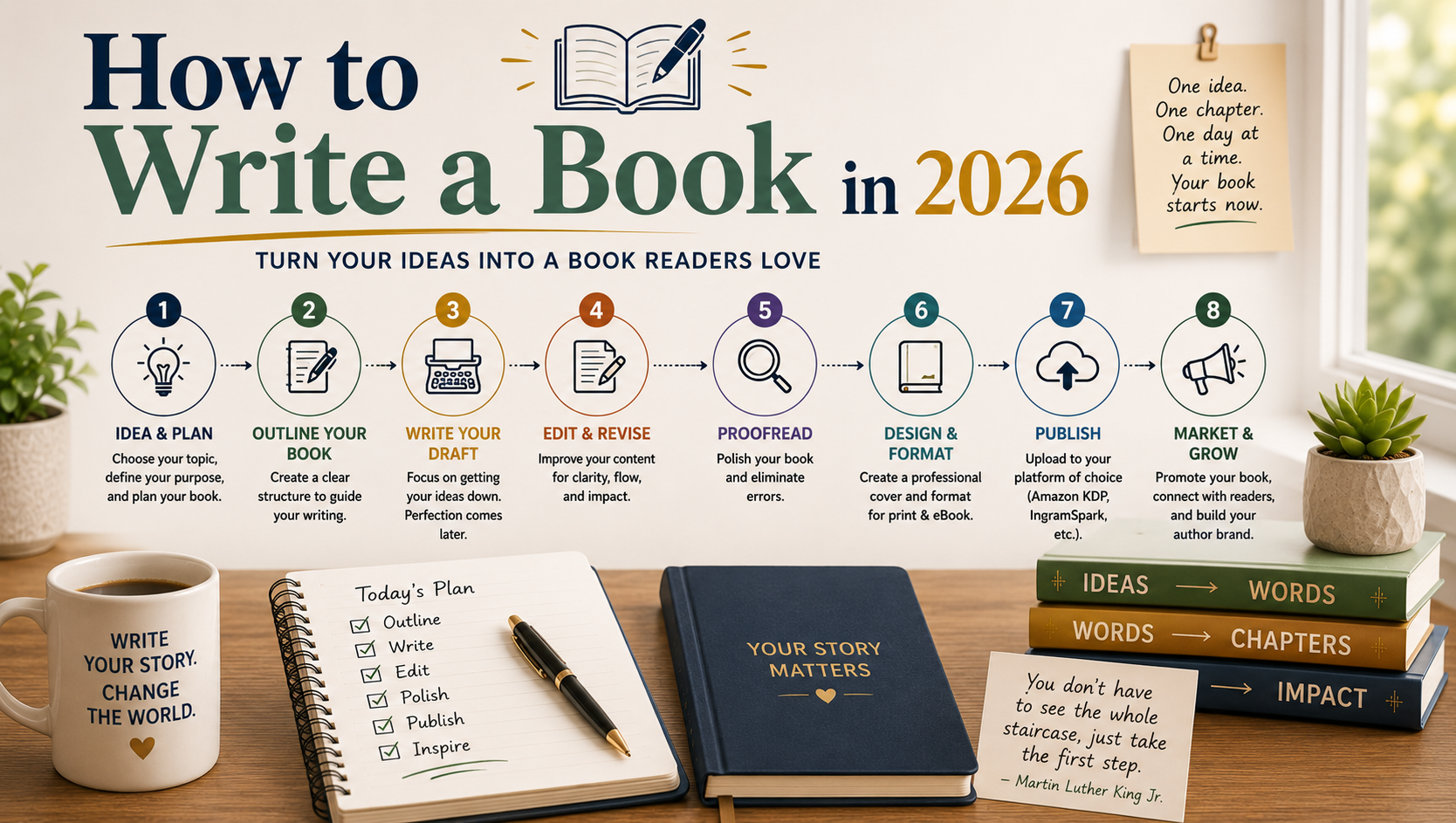
A book is no longer just something a person reads in a chair. It is something a person may skim on a phone, hear through earbuds, underline on an e-reader, or abandon after three distracted minutes.
A Book Must Earn Attention Before It Can Hold It
This is the strange dignity of writing now. That is why the question of how to write a book in 2026 is not really about speed, hacks, or software. It is about pressure. What can a writer make that survives friction: distraction, competition, format shifts, and the deadening ease of producing more text than thought?
The writer in 2026 is not only competing for attention. The writer is competing for belief. That changes the work in useful ways. In this article, we’ve touched on the best tips for writing a book in 2026. Read on to stay updated with the writing trends.
How to Write a Book in 2026
The first mistake many new writers make is thinking the book begins with a plot. It usually does not. It begins with pressure. A person wants something and cannot get it cleanly. A family has a silence at its center. A city is changing faster than the people inside it. A narrator is lying to others or to the self. A marriage looks stable from the curb and cracked in the kitchen. A good book does not start with “what happens next?” It starts with “what hurts here?” or “what is unsettled here?” or, sometimes best of all, “what is hidden here?”
That is especially true now because the market is too noisy for books built from a cloudy impulse. The writer who says, “I want to write about friendship,” has not yet arrived at the live wire. The writer who says, “I want to write about two friends who inherit a restaurant and discover that each has been keeping a different promise to the dead owner,” is closer. The book comes alive not when the theme is named, but when the tension sharpens. Whether you are writing on your own or collaborating with a book writing service, a compelling central conflict will always matter more than a broad idea.
Begin With Pressure, Not Just a Plot
A useful way to begin is with one burning question, small enough to hold in the hand. Not “What is grief?” but “What does a son do with the voicemail he still cannot delete?” Not “What is ambition?” but “What does a woman risk when success asks her to speak in a voice she no longer trusts?” A book is long, but its engine is often short. One precise question can carry three hundred pages better than ten noble ideas.
This is where many of the best tips for writing a book are less like motivation and more like subtraction. Strip away the essays, and the book is trying not to become. Strip away the biography that matters only to the writer. Strip away the generality. Then ask four rude questions. Who wants what? What stands in the way? Why now? What changes if they fail? If the writer cannot answer those, the draft may still begin, but it will likely sprawl.
There is no shame in starting small. In fact, small is often where the force hides. A book should not try to sound important at the start. It should try to sound alive. The grander the opening statement, the more likely it is to float. The more exact the scene, the more likely it is to land. A hand on a chipped plate. A dog that will not come inside. A brother laughing at the wrong moment at a funeral. These are not decorations. They are doors.
For anyone wondering how to write a book in 2026, the answer is less futuristic than expected. Begin with one difficult human knot. Then, stay near it long enough for the form to grow around it.
Give the Draft a Clear Job
The most useful new writing technique for 2026 remains the simple traditional writing basics: drafting.
Before starting to write a book, it should be clear what the book is all about. In other words, you have to ensure what you are going to talk about in each chapter, on each page. The more you have clarity on your idea, the better your book will form. To further elaborate, know what is happening in the scene? Who enters with power? Who has changed? Where does the pressure rise? What detail anchors the reader in place and time?
In this pass, the writer does not fuss over pretty language. The point is to make the scene move. A chapter without movement becomes a memo. Many early drafts die because the writer confuses information with drama. Information can be useful; drama changes the temperature.
The second pass is for sound. This is where the writer reads the chapter aloud, slowly, with no actor’s flair, just enough voice to hear its actual shape. The ear catches what the eye excuses. It hears when three sentences in a row begin the same way. It hears when every person in the room somehow speaks with the same rhythm. It hears when a pronoun arrives before the ear knows who “she” is. It hears the dead patch in the paragraph where the writer started explaining, because the scene was no longer doing enough by itself.
This is where the Draft earns its keep. When the writer stumbles, the page is not merely awkward. It is often untrue. A muddy sentence usually points to a muddy thought. A bloated sentence usually hides fear: the fear that the plain version is not clever enough, deep enough, literary enough. But readers rarely leave because the prose is too clear. They leave because the prose has stopped making contact.
The third pass is for the echo. After the chapter is solid on the page and clean in the ear, the writer asks: What should ring after this scene ends? A gesture? An image? A line? A new unease? The best chapters do not simply conclude; they reverberate. A daughter pockets a key she should have returned. A husband notices that his wife now uses his full name. A scientist deletes one file and keeps another. Something small changes in air pressure. That is the echo.
Used well, this method does three things. It keeps the writer from confusing drafting with finishing. It makes revision less vague because each pass has a job. And it trains the book to carry both silent reading and spoken narration. That matters in a market where audiobook listening is broad and growing, and where digital audio has become a strong share of adult-book revenue. A writer does not need to become a performer. The book just needs to stop hiding from the voice.
The Draft also helps with a modern problem that feels technical but is really artistic: overproduction. In a world where words can be generated instantly, the real mark of a writer is not output alone. It is a selection. What stays. What goes. What earns its place. A machine can give a hundred versions. A writer decides which one has a pulse.
There is an ethical grace in that, too. The Authors Guild’s guidance on AI use treats these tools as aids for research, outlining, brainstorming, and certain support tasks, not as replacements for the writer’s own expressive labor. That distinction matters because style is not a garnish on top of thought. Style is the pattern of thought. It is how judgment sounds. The U.S. Copyright Office’s recent AI reports, along with the Authors Guild’s Human Authored initiative, have made plain that the line between assistance and authorship is not a side issue. It is becoming central to how books are made, sold, and trusted.
What the Draft offers, then, is not merely polish. It offers authorship. It asks the writer to return to the page with the body fully involved: eye, ear, breath, memory, judgment. A first draft may be private. A real draft is accountable.
Every Chapter Must Change Something
If the premise is the engine, the chapter is the gear. One of the best tips for writing a book is to stop thinking of chapters as containers for information and start thinking of them as units of change. Something must tilt. It need not explode. Quiet books change, too. But if a chapter opens in one emotional weather and closes in the same one, the writer should at least ask whether it needed to exist in full.
Change can be external. A secret is revealed. A door opens. A decision is made. But internal change is often stronger. A chapter is alive when a reader can sense, even faintly, that the story is moving with pace, and cannot go back to how it was in the beginning.
This is why scene beats matter more than clever sentences. A scene generally needs a desire, resistance, and a turn. Someone wants. Something pushes back. By the end, the want has shifted, deepened, or been exposed. That shape may sound basic, but most broken chapters fail in one of those places. Either nobody wants anything clear enough, or nothing pushes back hard enough, or the end lands exactly where the start did.
Many new writers, especially very bright ones, fall in love with summary because summary feels efficient. It lets the writer cover years, explain motives, and skip the messy business of dramatizing. But the summary should serve the scene, not replace it. If a marriage is ending, the reader likely needs at least one room in which that ending becomes undeniable. If a child stops trusting a parent, there should be a moment when trust is not merely reported as gone but shown as cracking.
The writer in 2026 should be especially wary of soft abstraction. The language of abstraction spreads fast because it sounds competent. People are “complex.” Relationships are “fraught.” Memory is “fragmented.” But a book earns those words through scenes. It earns “fraught” by showing a son calling his father “sir” by mistake. It earns “fragmented” by showing a woman remembering the smell of gasoline before she can remember the date. Fiction and narrative nonfiction do not become rich by using more abstract language. They become rich by giving abstraction a body.
This, too, is part of how to write a book in 2026. The reader’s attention is under pressure. The answer is not panic, and it is not louder plotting. It is a better scene construction. The books that survive do not merely move quickly. They move decisively.
Use AI for Support, Not for the Soul of the Book
For a beginner, one of the useful pieces of writing advice for 2026 may be this: take AI help for writing, but do not expect it to charge your emotions and soul that your work is missing.
AI tools can brainstorm chapter titles, generate outline options, offer research questions, summarize source material, and produce a rough plan in seconds. But it will still miss its mark unless you add the human element to it.
A writer should know that border. Using a tool to sort research is one thing. Using it to draft a scene whose feeling the writer has not yet earned is another. Asking for ten possible structures for a nonfiction book may be useful. Asking for the paragraph that introduces the mother’s funeral is usually a mistake, because that paragraph is where the writer’s true work begins, not at the level of typing, but at the level of moral and sensory choice.
The culture is telling writers this in several ways at once. The Authors Guild has published best practices for authors using AI, and the Copyright Office has spent the past two years issuing reports on copyrightability and training issues in generative AI.
This also means the writer should be strategic. Let tools speed up what is mechanical. Do not let them replace what is intimate. A good test is simple: if the passage depends on taste, memory, surprise, moral pressure, or emotional timing, the writer should probably write it. Those are not side features of literature. They are the thing itself.
There is also a craft danger that hides beneath the ethical one. When a writer outsources too much language too early, the book begins to sound finished before it has actually discovered what it is. The sentences may appear clean, but they are often generic in the deepest sense: they could belong to almost anyone. The problem is not merely that the prose sounds machine-made. The problem is that the writer no longer hears what is missing. Ease can dull judgment.
A wiser use of new tools is to protect the scarce hours for the work only a human can do. Use software to organize notes. Use voice memos to catch living sentences while walking. Use transcription if it helps turn thought into raw material. Use a research assistant, human or digital, to find the missing dates, names, and maps. Then return to the page and decide what the scene means, how the image lands, where the chapter ends, and which sentence is too proud of itself to stay.
Writing advice for 2026 should be practical enough to live with. A writer does not need purity. A writer needs command.
Turn a Large Book Into Small, Repeatable Tasks
Most writing goals fail because they are too grand at the sentence level and too vague at the calendar level. “Write a novel this year” is noble, but it does not tell Tuesday what to do. Better writing goals for 2026 begin with units small enough to survive in real life. A scene. Five hundred words. Forty minutes before work. Two Saturday hours at the library. Three chapters revised by month’s end. A book is built on repeatable acts, not moods.
The writer should think of three kinds of goals. There is the output goal: how much new work gets made, and how often. There is the craft goal: what specific skill gets better during the season, such as dialogue, chapter endings, or scene compression. Then there is the completion goal: what milestone arrives by a real date. A first act by June. A full draft by September. A revision pass before the holidays. Without the third kind, writers often confuse constant effort with progress.
The calendar should also match the stage of the book. Early drafting needs looseness. Revision needs precision. Research needs boundaries. Do not be overly critical when writing the first draft. Keep the self-judgement as low as you can.
Once you are done, keep one week for the structure revision, one week for the grammar, one week for dialogues, repeated images and so on. If you try to do everything at once, you may burn yourself at all stages.
There is another, quieter rule: goals should honor energy, not fantasy. Some writers can do brilliant work at dawn. Others are most alive after midnight. Some need silence. Some need a café. The point is not to imitate a glamorous routine. The point is to study the actual conditions under which the writer produces honest pages. The book does not care whether the schedule looks noble. It cares whether the pages arrive.
This is where many of the best tips for writing a book turn from abstract wisdom into carpentry. Track sessions, not just inspiration. End a writing day a few lines before empty, so tomorrow has a door back in. Keep a live note titled “Next scene,” so the book is never waiting in total darkness. Protect one reading hour a week devoted to books in the form the writer is attempting. The writer who wants to craft a quiet literary novel should not read only advice about quiet literary novels. The writer should read the novels themselves and notice how they move.
Writing goals for 2026 should also leave room for humility. Some days the work will be weak. Some weeks it will stall. The task is not to feel like a writer. The task is to return like one.
Audiobook Narration: Write for the Ear as Well as the Eye
One of the most overlooked book writing tips for 2026 is to write for audiobook narration even if the book first appears in print. This does not mean writing theatrically. It means writing with acoustic clarity. The line should carry. The scene should be legible by ear. The listener should not drown in pronouns, identical names, mushy dialogue, or paragraphs so long they lose their own spine.
The business case is not trivial. The Audio Publishers Association reported $2.22 billion in audiobook sales for 2024, up 13 percent from the year before, with digital audio accounting for 99 percent of revenue. Its 2025 consumer survey found that 51 percent of U.S. adults had listened to an audiobook. In adult books, digital formats, including audio, now account for a substantial share of revenue, and digital audio had another solid year in 2025. That means a writer is no longer preparing for a niche side format. The writer is preparing for one of the main ways a book now travels.
What does that change on the page? First, names matter. If four main characters have the same first letter, the ear suffers. If two names sound alike, the ear works too hard. Second, dialogue tags and beats matter more than many writers realize. A page full of “he said” and “she said” is usually fine. A page where six people speak in rapid succession without enough anchoring may be fine in print and confusing in audio. Third, syntax matters. A long sentence can be lovely, but it must know where its breath lives.
A practical narration pass helps. Read each chapter aloud and mark three things. Mark where the tongue trips. Mark, where the ear loses track of who is doing what. Mark, where emotion is being announced rather than embodied. These spots often reveal deeper craft issues. If a listener cannot follow a scene, the problem may not be audio at all. It may be staging. If a paragraph sounds flat, the problem may not be rhythm alone. It may be that the image is secondhand.
Writers of nonfiction should pay special attention to transitions. On the page, a subhead or visual break can rescue the reader. In audio, the sentence must carry more of that burden. The listener needs orientation. Where are we? Who is this? Why now? What changed from the last paragraph? The book does not need to over-explain. It needs to guide.
Writers of fiction should notice how spoken prose handles desire and tension. Dialogue that looks sharp on the page can sound thin when read aloud if every line is built to look clever rather than to reveal pressure. A narrated novel exposes vanity fast. So does a memoir. The voice has to believe itself.
This is why audiobook narration belongs in any serious book writing guide for 2026. It is not a marketing afterthought. It is a craft test. The sentence that can stand in the air tends to stand on paper, too.
Understand the Market Without Letting It Control the Manuscript
A good book writing guide for 2026 must tell the truth about market signals without letting the market write the book. Trend awareness is useful. Trend obedience is fatal. The writer should know what readers are buying, what shelves are growing, what formats are expanding, and what genres feel crowded. Then the writer should return to the manuscript and ask a different question: what promise is this book truly making?
The publishing data, at least right now, offers a few clear signals. Fiction has been growing across many international markets while nonfiction has been under pressure in many territories. In the U.S., romance has remained a strong growth category, with romantasy and sports romance showing especially sharp gains in 2025. At the same time, adult nonfiction remains large, and self-help had a striking year in 2025, rising 14.7 percent. These are useful facts, but they are not marching orders. They do not mean every new writer should produce a romance novel or a self-help manifesto by summer. They mean readers respond to strong promises delivered with confidence.
The word “promise” matters. A thriller promises escalation and surprise. A romance promises emotional tension moving toward union or rupture. A memoir promises a mind wrestling honestly with experience. A self-help book promises usefulness shaped by a distinct point of view. Trouble begins when a writer wants the market heat of one category without honoring its actual contract with the reader.
That is why genre is not a prison. It is a language of expectation. The writer should know the shelf, know the mood, know the pace, and know the size of the reader’s desire on entry. Then the writer can bend those expectations or deepen them. But the writer should at least know what is being bent.
The same realism applies to publishing paths. Traditional publishing, independent publishing, and service-based support all ask for different skills, timelines, and risks. The self-publishing sector remains large and growing; Bowker’s most recent figures showed more than 2.6 million self-published ISBN titles in 2023. That abundance is energizing, but it also means writers need clear eyes about packaging, editing, metadata, design, distribution, and fraud. The Authors Guild has warned of a rise in scams targeting authors, and Penguin Random House says scammers have impersonated publishers, agents, and even executives while seeking bogus fees from writers. Reputable publishers do not charge reading fees to consider a manuscript, and reputable agents do not require up-front payment for representation.
So the final part of a serious book writing guide for 2026 is not dreamy at all. Vet help. Read contracts. Ask what service is being provided, by whom, for how long, and with what rights. A writer does not need to become cynical. A writer does need to become literate in the business side of hope.
Final Thought
A book, in the end, is still one voice trying to cross the dark and reach another mind intact. That was true before the screen, before the feed, before synthetic language, and it remains true now. The sentence must still carry. The scene must still turn. The writer must still decide what is worth saying and then say it in a way no shortcut can counterfeit.
For authors who have the story but need professional help shaping, writing, editing, or publishing it, Blue Mount Publishers offers book writing and publishing services with reasonable and affordable pricing. The most useful help, though, is the help that preserves the writer’s own voice.
Frequently Asked Questions About Writing a Book in 2026
What are your writing goals for 2026?
Strong writing goals for 2026 should be specific enough to guide a week, not just flatter a dream. A useful plan might include finishing a first draft, improving one craft skill such as dialogue or pacing, and building a reading habit that supports the book’s form. The smartest goals are layered: a daily or weekly practice goal, a monthly milestone, and a completion target. Instead of saying “write a book,” a writer might aim to draft four scenes a week, revise one chapter every weekend, and finish a complete manuscript by a fixed season. Goals work best when they measure return, not perfection.
Can I write a book with AI tools in 2026?
A writer can use AI tools in 2026, but the wiser question is how. The strongest use is support work: research triage, outline testing, brainstorming, transcription, or administrative help. The riskiest use is replacing the writer’s own expressive labor in scenes, analysis, voice, or emotional turning points. The Authors Guild’s best practices frame AI as a tool that may assist parts of the process, while the broader culture is becoming more alert to questions of authorship, disclosure, and trust. That is one reason Human Authored certification has expanded. A good rule is simple: let tools save time, but do not let them replace judgment, style, or memory.
Which book genres will be popular in 2026?
The best current signals suggest that romance in its newer branches, especially romantasy and sports romance, remains powerful, while fiction more broadly has been outperforming nonfiction in many markets. In the U.S., romance continued to grow in 2025, and self-help also had a notably strong year. That said, “popular” can mislead a writer if it becomes a crutch. The deeper lesson is that readers still want a clear emotional or practical promise. A writer should study the market to understand demand, but should not chase a trend so late that the book loses its own reason for being. By the time a trend becomes obvious, the more durable edge is often specificity.
What are the 7 strategies of writing?
A useful seven-part strategy looks like this in practice: read deeply in the form being attempted; define one sharp central question; build scenes around desire, resistance, and change; draft before judging; revise aloud for clarity and sound; seek feedback after the writer has done a serious self-edit; and learn the publishing path before the final draft is done. These strategies work because they cover both art and process. They ask the writer to improve not only the sentences, but also the habits that make good sentences more likely. None is glamorous, and that is part of their value. Books are usually finished by steady systems more often than by dramatic bursts.
How long does it take to write a book in 2026?
It still depends on the kind of book, the writer’s schedule, the research load, and how much revision the manuscript needs. Many first books take longer than expected because the writer is learning the form while making the work. A lean nonfiction book with a clear structure may come together in months; a novel may take a year or several. The better answer is that writing time should be measured in stages. Drafting, cooling off, structural revision, line revision, outside feedback, and final polish each need their own season. The writer who plans only for drafting is usually surprised by how much of the real work begins after “The End.”