
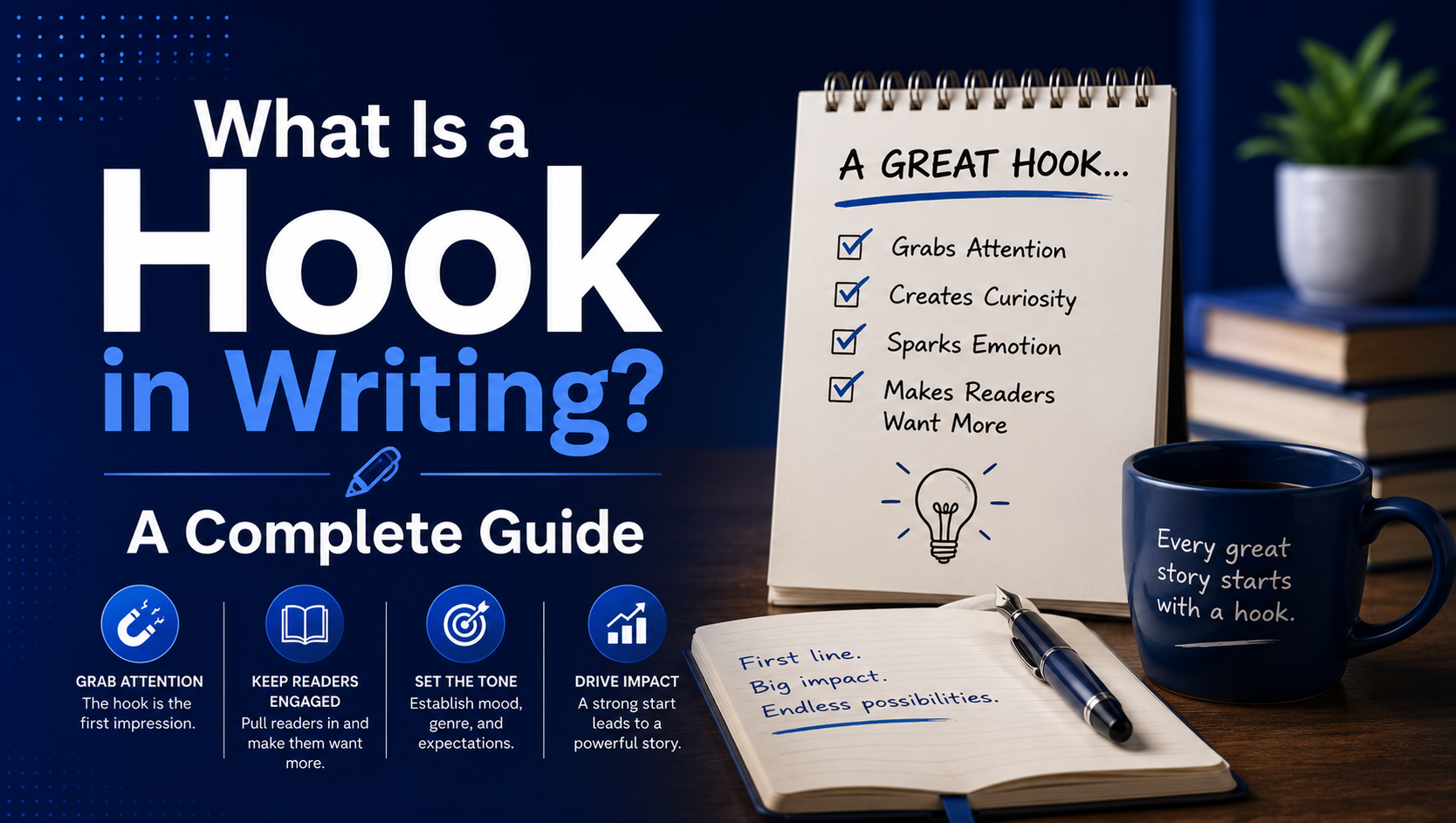
A reader can leave in seconds if the first few lines aren’t what they want to read. As a writer, you’d want to grab their attention from the first go. That is the purpose of a hook in writing.
Hook has become an integral part of digital writing. Since readers are constantly bombarded with text on their news feeds, emails, and websites, they read articles, social posts, and books in one way or another. Therefore, writers have to compete for attention.
Understanding hooks for writing therefore means understanding something deeper than sentence craft. It means understanding curiosity. It means knowing which detail to reveal, which question to raise, and which information to hold back for a moment. A strong opening does not force the reader forward. It makes going forward feel natural.
What Is a Hook in Writing?
A hook in writing is an attractor that seeks to grab the reader’s attention. The purpose is to stop them from reading past the line. A hook could be a statement, a visual, or a question. It not only captures the attention of the reader, but also encourages them to read the whole text.
Just as the hook is designed to catch the target, the hook also throws the breadcrumbs in order to hook the reader. However, it should be noted that a hook does not grab readers through force. Rather, it creates enough engagement and curiosity through relevance, emotion, surprise, or tension.
Consider two ways of opening an article about sleep.
The first might say:
For physical and mental health, sleep is very important.
This is a fact, an everyday statement. It is also easy to leave.
A stronger opening might say:
At 3:17 every morning, our bedroom ceiling begins to feel like a problem that must be solved.
Now, as a reader, when you read this sentence, you’d wonder who is up there, why the person is not able to sleep, or you could relate it to your own situation to know what next. In other words, the second opening gives the mind something to follow.
This is the basic purpose of a hook. It turns information into movement.
In an essay, the hook may introduce a question. In a novel, it may place a character in an unusual situation. In journalism, it may begin with a revealing scene. In a blog, it may name a problem that the reader recognizes at once.
The form changes. The principle does not.
Why a Good Hook Matters: The Importance of a Good Hook
The importance of a good hook cannot be undermined.
Most readers do not begin a piece by making a firm promise to finish it. They test it. They read a sentence. Then another. At each point, the writing has to provide enough value, interest, or momentum to justify the next line.
A sentence may lure you to read the first line, but you’d always test the first paragraph to find the value or interest. The first line has to justify the next line, until the reader finds the momentum to continue reading the whole page.
Your opening hook must begin building that context immediately. Now, this does not mean that every opening should have to be dramatic. Sometimes, a lazy, laid-back sentence is enough to draw the reader’s attention.
This does not mean every opening must be dramatic. In fact, writers often damage good material by trying too hard to sound important. A quiet observation can create more interest than a huge claim.
Imagine a personal essay about a family restaurant.
A weak opening might announce:
Family businesses teach people many valuable lessons about life.
A better opening could begin:
Every Friday night, the smallest table in the restaurant belonged to a man who never ordered from the menu.
Every Friday night, the smallest table in the restaurant is booked for a man who would never order from the menu.
The second sentence doesn’t try to explain anything. Rather, it leaves room for the reader to develop meanings as they read.
That restraint matters. Effective openings often trust readers enough not to explain everything at once.
A literary hook works because it creates a promise. The promise between the writer and the reader is of intellectual, emotional, and dramatic value. This promise guarantees the readers that there’s something worth their attention.
Types of Hooks for Writing
When you understand different types of hooks for writing, you have the room to bring in creativity.
These hooks could be:
- Question
- Fact
- Bold statement
- Quotation
- Visual scenes
The Question Hook
A question hook is a deliberate, open-ended space left in the readers’ mind. Once they read the question, their mind will try to answer it. They will begin looking for the answer.
For example:
What happens when your career, for which you have spent 20 years, disappears in one night?
The question works because it contains stakes. Something has changed. The reader wants to understand what follows.
If the question hook is generic, it may fail. For example,
Have you ever wondered about life?
Technically, it is a question. But it does not leave room for the reader to breathe in and search for an answer.
A better question is specific:
Why do we remember our childhood room so vividly when we clearly forget the last year?
Where are question hooks used? Well, they are mostly used in the nonfiction genre, such as:
- Explanatory articles,
- Essays,
- Non-fiction
- Speeches
In fiction, question hooks are appeared through image, action, or tension.
The Statistic or Fact Hook
A striking fact can open a subject quickly because it gives the reader something solid.
The key word is striking.
A fact is not automatically a hook merely because it contains a number.
Suppose an essay concerns household food waste. An opening that says, “Food waste is a serious global problem” provides context but little energy. A precise fact about how much food a typical household throws away may create a stronger entry because it turns an abstract problem into something measurable.
Still, facts should never be used merely to shock.
A statistic must be accurate, relevant, and properly sourced when publication standards require sourcing. Writers should also explain why the number matters. A giant number without context may look impressive while telling readers very little.
Good fact hooks create understanding.
Bad fact hooks create noise.
The Anecdote Hook
An anecdote hook is the one that begins with a small story. This story may be ordinary, but it would reveal the larger context of the story.
For example:
The instructor understood that the lesson had failed when John raised his hand for the fourth time and asked the same question.
In the above sentence, the reader is introduced to a person, setting, or a problem in the beginning. Good hooks for writing an anecdote.
The danger is length.
Some writers spend several paragraphs telling a charming story before revealing why the story matters. The anecdote then becomes a separate performance rather than a doorway into the article.
A hook should lead somewhere.
The Quote Hook
A quotation can be an effective opening when the speaker’s words contain tension, insight, or surprise.
A quotation hook is the one that uses someone’s emotive expression for the opening sentence. This type is used when there’s tension, an insight to be revealed or a surprise.
However, a little caution is to be made here. Familiar words rarely create fresh curiosity. The stronger approach is to choose a quote that reveals something important about the subject.
A profile might begin with an unusual statement made during an interview. A history essay might open with a short line from a letter. A cultural article might begin with words that capture a conflict the piece will examine.
The quotation should perform work.
If it could be removed without changing the reader’s interest, it probably is not the right hook.
The Bold Statement/Controversial Hook
A bold statement/controversial hook is the one that states a claim. This claim could be thumb-stopping, a bit passive aggressive, or an argument for the ongoing debate. The goal is to stop the reader from thinking whether the claim is true or not.
For example:
The hardest part of writing is deciding which good words to delete.
This kind of opening works because it challenges an assumption without becoming absurd.
The line between bold and exaggerated, however, is thin.
“Everything writers know about storytelling is wrong” may attract attention, but the claim is so large that the article is unlikely to support it.
A good bold hook creates productive tension.
It should make the reader think, “Why?”
Not, “Surely that cannot be true.”
The Description or Scene-Setting Hook
Some of the strongest hooks for writing begin with a place.
The room is too quiet. The bus is later than usual. Rain is pouring outside the window. A child is waiting outside an office. A mother is staring at a result that should not exist.
A scene works because readers can enter it. They can feel that there’s already pressure.
Scene-setting hooks are used in long-form feature articles, memoir writing, fiction, and narrative non-fiction. The purpose is to create an experience for the reader before the writer even starts to explain what happens, and what it means.
Hooks for Narrative Writing vs. Hooks for Writing Essays
No two hooks are used for the same job. A fictional opening often needs to create story movement. An essay opening usually needs to create intellectual movement.
This distinction matters when writers choose between hooks for narrative writing and hooks for writing essays.
Both need curiosity. They simply create it in different ways.
Hooks for Narrative and Fiction Writing
Hooks for narrative writing are used to introduce something new. It could be a change, underlying tension, a contradiction, or a mystery.
That does not mean the first page needs an explosion.
A character can simply notice something that does not fit.
The light in the empty house is on.
A letter arrives years too late.
A bride recognizes someone in the final row.
A child hears adults stop talking when she enters the kitchen.
Each situation produces a question without stating the question directly.
Narrative hooks work best when they connect the dots to know what happened. They can linger on for hours if they begin to care who it happened to.
This is why an opening such as “The spaceship exploded at midnight” may be less effective than expected if the reader does not yet understand who is affected. Action alone is not tension. Tension comes from meaning.
Therefore, good narrative hooks not only give enough information to hook the readers with FOMO, but also keep them reading on.
Hooks for Essay and Academic Writing
Effective hooks for writing essays usually open a path toward an argument.
The hook may introduce a question, contradiction, brief scene, relevant fact, or surprising observation. But it should fit the subject and lead smoothly toward the thesis.
Imagine an essay about public libraries.
A writer could begin with a giant claim about the death of reading. Or the writer could begin with something more concrete:
At 8:55 on a winter morning, people are already waiting outside the library doors.
That scene gives the essay somewhere to go. Who is waiting? Why? What does the library provide that other places do not?
The essay can move from the image toward a larger argument about public space, access, technology, education, or community.
Academic writers sometimes avoid hooks because they fear sounding informal. That caution is understandable. Serious work should not be turned into entertainment for its own sake.
But clarity and curiosity are not enemies of serious thought.
A carefully chosen opening can make an argument easier to enter without making the argument less rigorous.
The Method of Creating a Hook
Many writers imagine that great openings arrive in a flash.
Sometimes they do.
More often, they are revised into existence.
The most reliable method of creating a hook is not waiting for inspiration. It is identifying what the reader most needs to feel, know, or wonder before entering the main idea.
That process can be broken into five useful steps.
Step 1: Identify the Reader’s Core Curiosity or Pain Point
Before writing the first sentence, the writer should ask a simple question:
Why would this reader care?
Not why should the reader care. Why does the reader already care, even if only slightly?
An article about editing may appeal to a writer who worries that a manuscript is not ready.
A piece about saving money may speak to someone who feels anxious each time a bill arrives.
A novel may appeal to the desire to know what happens when an ordinary life suddenly changes.
The hook should touch that existing concern.
This is especially important in online writing, where generic openings lose attention quickly.
If the reader’s problem is “I cannot make my opening interesting,” a useful hook should address the frustration directly rather than spend three paragraphs discussing the ancient history of rhetoric.
Relevance creates attention faster than decoration.
Step 2: Choose the Hook Type That Fits Your Content and Audience
Once the central curiosity is clear, the writer can choose among different types of hooks for writing.
A fact may suit a research-based article.
A scene may suit a profile.
A question may suit a guide.
A surprising statement may suit an opinion essay.
A brief anecdote may suit almost any form if it leads naturally to the subject.
The best type depends on tone as much as topic.
A serious article about grief should not open with a playful trick simply because playful openings attract clicks. A children’s adventure may need more motion than a policy essay. A business article can use a story, but the story must eventually deliver useful insight.
Fit matters.
A hook is part of the piece, not packaging around it.
Step 3: Draft Multiple Versions
The first opening a writer creates is often the most obvious one.
That is exactly why writers should create more than one.
Suppose an article begins this way:
Writing a good opening is important because it keeps readers interested.
The sentence explains the subject, but it does not demonstrate the idea.
A revised version might say:
A writer can spend six months perfecting a manuscript and lose a reader in six seconds.
The second line carries the same basic meaning, but it gives the thought shape and tension.
The improvement did not require a larger vocabulary. It required a sharper image.
Writers can try several versions: one question, one scene, one fact, one bold statement, one short anecdote.
Then they can compare.
This technique works because choice improves judgment. A writer staring at one opening asks, “Is this good?” A writer staring at five openings can ask, “Which of these creates the strongest reason to continue?”
That is a much easier question to answer.
Step 4: Cut Anything That Delays the Hook’s Impact
Writers often hide their best sentence.
It sits at the bottom of the first paragraph, underneath greetings, background information, definitions, or cautious setup.
Revision often means moving that sentence up.
Consider:
There are many challenges people face when they begin writing a novel. Writing a novel can take a great deal of time and effort. One important challenge is learning how to begin. Some writers rewrite their first page more than any other page.
The final sentence is the interesting one.
So begin there:
Some writers rewrite the first page more than any other page in the book.
Now the reader has something specific to consider.
Cutting does not mean making every introduction extremely short. Long openings can work beautifully. But each sentence should be pulling the reader deeper into the piece.
If a sentence merely delays the interesting part, it has probably earned deletion.
Step 5: Test It: Read It Aloud and Get Feedback
A hook should work in the ear as well as on the page.
Reading aloud reveals problems writers often miss while reading silently. A sentence may contain too many clauses. The important word may arrive too late. The rhythm may feel flat. A clever phrase may sound forced when spoken.
The writer can also ask an early reader a useful question:
“What did this opening make you expect?”
That question is better than simply asking whether the person liked it.
If the answer matches the direction of the piece, the hook is doing its job.
If the reader expects a mystery but the article becomes a technical guide, the opening may be making the wrong promise.
The best hooks attract the right curiosity.
Literary Hook Examples: How a Literary Hook Creates Curiosity
A literary hook often feels different from a direct informational hook because it does not explain its purpose immediately.
It creates atmosphere, character, uncertainty, or tension first.
Consider this invented opening:
The letter had been on the kitchen table for three days before anyone admitted to opening it.
The sentence creates several questions. What was in the letter? Who opened it? Why did everyone pretend otherwise?
Notice how little information is required.
Now consider:
By the time Mr. Hale learned his daughter had left town, she had already crossed two state lines.
Again, the reader knows almost nothing, yet the situation has changed.
A literary hook often works through controlled absence. Something important is missing, delayed, hidden, changed, or misunderstood.
This technique can also work outside fiction.
A feature about a closed factory might begin:
For three weeks after the factory shut down, the parking lot lights still came on every night.
The image is simple. Its meaning is not.
That difference matters.
A strong literary opening does not always tell readers what to think. It gives them something worth thinking about.
Writers should also notice that these examples use ordinary words. There is no need for decorative language.
Specificity does more work than ornament.
Good Hooks for Writing Do Not Need to Be Loud
One of the most common misunderstandings about good hooks for writing is the idea that the opening must shock the reader.
It does not.
A quiet sentence can be powerful if it creates a meaningful question.
For example:
My father kept every key to every house he had ever lived in.
Nothing explodes. Nobody disappears. There is no dramatic statistic.
But the detail carries possibilities.
Why did he keep the keys? What did those homes mean to him? What does the habit reveal about memory, loss, family, or belonging?
Curiosity can whisper.
In literary work especially, a writer who pushes too hard for immediate drama may destroy the natural tone of the subject.
The goal is not maximum intensity.
The goal is maximum relevance.
Common Mistakes That Weaken a Hook in Writing
Weak openings often fail in predictable ways.
One of the most common is starting too far away from the subject.
An article about revising dialogue does not need to begin with, “Since the beginning of human history, people have told stories.” The statement may be true, but it forces the reader to walk a long distance before reaching the useful material.
Another mistake is exaggerated urgency.
“You are destroying your writing without even knowing it!”
Such claims may produce a moment of attention, but they also reduce trust. Readers quickly learn when a headline or opening is trying harder to provoke emotion than deliver value.
A third problem is the obvious question.
“Do you want to become a better writer?”
Few readers will answer no. The question creates no real tension.
A fourth is the unrelated quotation. Writers sometimes choose a famous quote because it sounds impressive, then force a connection to the subject.
The opening should belong to the article.
Another common problem is excessive mystery.
There is a difference between withholding one useful piece of information and refusing to tell readers what the piece is about.
Curiosity needs structure.
Finally, writers sometimes produce a wonderful opening that promises the wrong article. A dramatic personal story may lead into a dry list of tips. A provocative claim may never be addressed again.
A hook is not separate from the writing that follows.
It is the first part of the argument, story, or experience.
When Self-Teaching Isn’t Enough: Getting Outside Help
Learning to write stronger openings is possible through reading, practice, revision, and careful comparison.
Writers can study the first pages of books they admire. They can examine magazine features, essays, opinion pieces, biographies, and narrative nonfiction. They can ask where curiosity begins and how quickly the writer provides context.
But writers also face a problem that practice alone cannot completely remove: familiarity.
After reading the same opening 30 times, the writer already knows everything that comes next. The mind fills in missing connections automatically. A vague sentence may feel clear because the writer knows what it means. A slow paragraph may feel necessary because the writer remembers why it was written.
A new reader does not have that advantage.
This is where outside feedback becomes valuable.
An editor can identify whether a hook creates useful curiosity or merely confusion. An editor can notice where the strongest line is buried, where a claim feels too large, or where the opening does not match the rest of the piece.
The purpose is not to replace the writer’s voice.
Good editing should reveal the strongest version of that voice.
Writers should remain cautious, however, about any editing approach that treats every opening according to one formula. Not every story should begin with danger. Not every article needs a statistic. Not every essay needs a question.
The opening has to serve the work.
Conclusion: A Hook in Writing Is an Invitation
A reader reaches the first sentence without owing the writer anything.
That is one of writing’s hardest truths. It is also one of its most useful.
The writer cannot demand attention. The writer has to create a reason for it.
A strong hook in writing may begin with a question, a scene, a fact, an unusual statement, a quotation, or a small human moment. The form matters less than the effect. Something changes in the reader’s mind. A question appears. A possibility opens. The next sentence suddenly feels necessary.
That is the quiet craft behind an effective opening.
The writer who understands it stops asking, “How can this sound impressive?” and starts asking a better question: “What would make the right reader genuinely want to know what comes next?”
And then the work becomes simpler, though never easy.
Find that point of curiosity.
Begin there.
Frequently Asked Questions About Hooks in Writing
What is a hook in writing, in simple terms?
A hook in writing is the opening part of a story, essay, article, speech, or other piece that gives readers a reason to continue. It can be a sentence, question, fact, scene, short story, quote, or surprising idea. A hook does not need to be dramatic. It simply needs to create interest that fits the subject. The strongest hooks lead naturally into the rest of the writing instead of feeling like a separate trick added only to attract attention.
What’s the difference between a hook and an introduction?
A hook is usually one part of an introduction. The hook catches the reader’s attention, while the introduction gives the reader enough information to understand the subject and direction of the piece. For example, an essay might open with a short scene as its hook, then explain the larger issue and end the introduction with a thesis. The hook creates curiosity. The rest of the introduction turns that curiosity toward the main topic. A strong introduction therefore needs more than an interesting first sentence.
What are the main types of hooks used in writing?
The major types of hooks for writing include question hooks, fact or statistic hooks, anecdote hooks, quotation hooks, bold statement hooks, and descriptive or scene-setting hooks. Writers can also use contradictions, mysteries, unusual observations, or brief moments of dialogue. No single type is always best. The right choice depends on the subject, reader, form, and tone. A personal essay may benefit from an anecdote, while a research article may work better with a relevant fact or an important question.
How long should a hook be?
A hook can be one sentence or several sentences. There is no fixed length. What matters is how quickly it creates interest. In an essay or short online article, the hook may be only one or two lines before the writer provides context. A literary feature or novel may spend a longer paragraph establishing a scene. The key is not to confuse length with strength. A hook should stop once it has created enough curiosity to move the reader into the next part of the piece.
What makes a hook effective for essays specifically?
Effective hooks for writing essays create interest while preparing readers for the actual argument. A good essay hook might introduce a relevant question, contradiction, fact, scene, or observation. It should connect naturally to the thesis rather than exist only for entertainment. Writers should avoid giant claims, unrelated quotes, and questions with obvious answers. The best essay hooks make the reader curious about the exact issue the essay will examine. They attract attention while also helping the argument begin to take shape.
Can a hook be a question?
Yes. Questions are among the most common kinds of hooks in writing, but the question needs to create real curiosity. Broad questions such as “Have you ever wanted to succeed?” usually feel weak because the answer is obvious and the subject is vague. A stronger question introduces a specific tension, such as, “What happens when the career a person trained for no longer exists?” A good question hook should point toward the subject of the piece and make readers interested in discovering the answer.
How do I know if my hook is working?
A useful test is to show the opening to someone who has not read the rest of the piece and ask what the first lines make that person want to know. If the reader’s questions match the direction of the article, essay, or story, the hook is probably working. Writers can also read the opening aloud and check for slow setup, vague claims, or extra words. Most importantly, the hook should create interest without misleading the reader about what the rest of the piece will deliver.
Is it worth hiring an editor just to fix my opening lines?
It can be, especially when the opening affects a larger project such as a book, article, query, memoir, or important essay. But the best editing usually looks beyond the first sentence. A weak hook may be a sign that the writer has not yet found the clearest focus, strongest scene, or most useful starting point. An experienced editor can help identify that deeper issue while protecting the writer’s natural voice. Writers seeking broader editorial guidance or Affordable Book Publishing Solutions can also explore the professional publishing and editorial support offered by Blue Mount Publishers, particularly when a strong opening needs to become part of a strong, publication-ready manuscript.