
You think your book is ready for publication right after you finish writing it. It cannot be called complete unless you’ve edited your draft. To become a book from a draft, it has to pass through different stages.
Since the advancement of AI tools, anyone can upload a file and call themselves a published author. It is that time of the age where millions of copies are flooding online. The interesting part is that they disappear into total silence. If you don’t want to end up unknown, you need to leverage your skills in time.
You need to organize your story, strengthen your structure, and ensure that your paragraphs read smoothly to be called a live story. Without further ado, let’s explore a skillset that is needed for your manuscript.
What Does Developmental Editing Focus On?
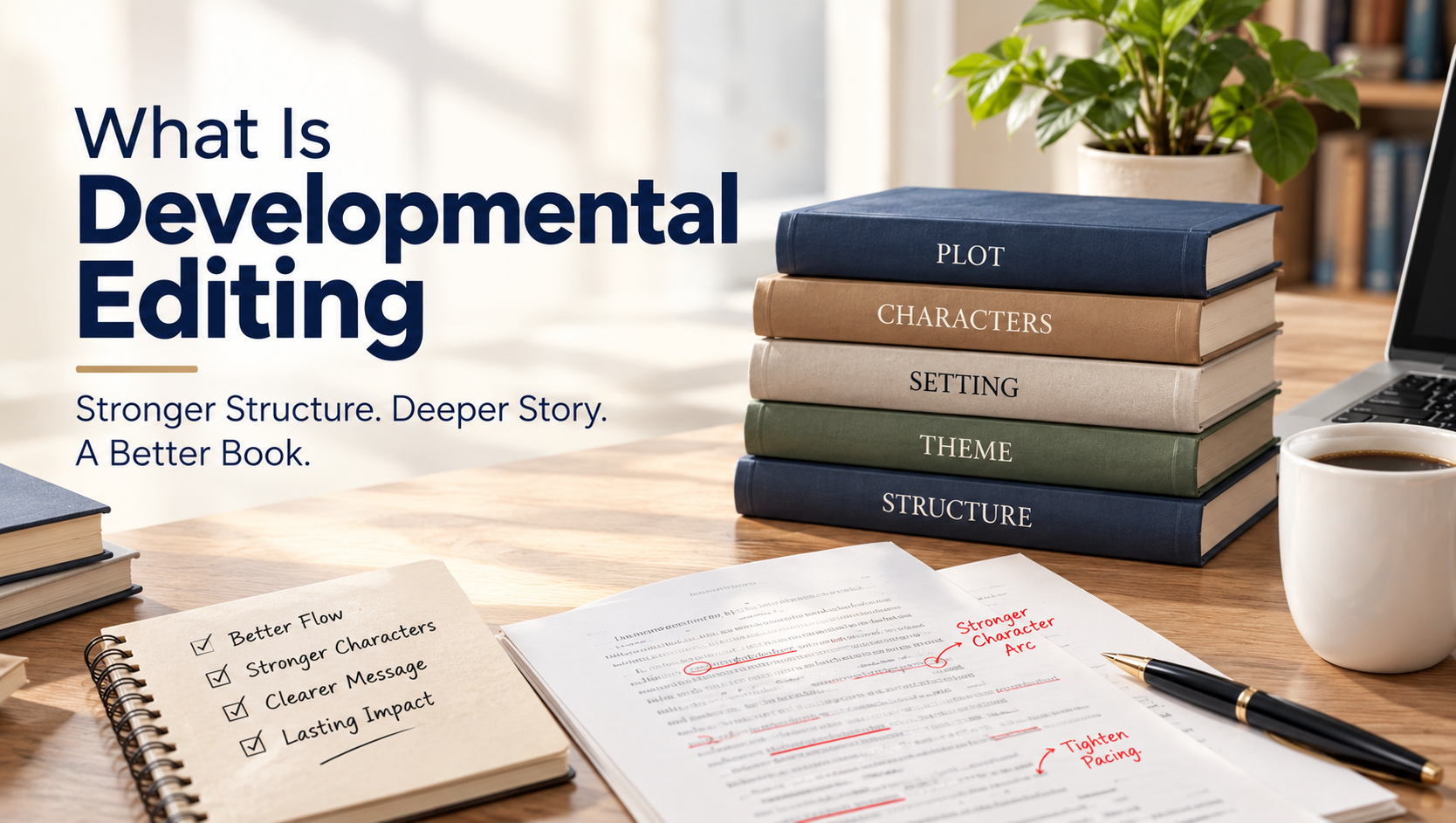
Every story has a micro level and macro level on which it is being judged. This macro level of editing is called developmental editing. To put it in plain words, developmental editing is a zoom-out view of your book that helps it become organized and groomed inside out.
Here’s an example from a construction site to make things easy for you. Suppose you are standing inside a room. You see a crack in the drywall. There are two things that this crack indicates: a. the entire foundation of the house is sinking, and b. you just need to paint over the crack. In both cases, you need a strong assessment to check for the foundation and the paint situation.
A developmental editor goes straight to the basement. They check the concrete. They do not care if you spelled a word wrong on page eighty. They care that your main character has no actual reason to hate the villain. They care that your plot just stops moving for fifty pages. They ask the terrifying questions. Does this book make any sense? Does it make readers move or experience the ethos and pathos? If your story misses its mark or fails to produce the impact you had anticipated, you may want to make some big changes.
Developmental Editing vs. Copyediting vs. Line Editing vs. Proofreading
Writers mix these jobs up every day. They pay someone a huge amount of money to fix their grammar when their plot is completely falling apart. Figuring out the difference here will save you cash, time, and a massive amount of heartbreak.
Think about building that house again. You cannot hang expensive wallpaper before you put up the wooden frames. Books work the exact same way. Let’s break down developmental editing vs. copyediting, and everything in between.
Developmental Editing
This is the architect phase. The developmental editor looks at your messy blueprints. They read your manuscript from ear to ear to ensure that your foundation is strong. If they find any potential threat that could hurt your story, they do all the heavy work. It can get messy, time-consuming, and frustrating, but it’s something that is absolutely important.
Line Editing
Okay, the walls are up. The roof keeps the rain out. Now, the line editor walks through the rooms. They care about the flow of the space. In a book, line editing focuses purely on the style and the music of your words. Do your sentences snap? Are you using the word “suddenly” twelve times in a single chapter? The line editor smooths out clumsy phrasing. They make your writing sound sharp, paragraph by paragraph.
Copyediting
The house is totally built. Now you need a strict city inspector. This is where copyediting comes in. Copyediting is all about ensuring the rigid rules of language are followed. A copyeditor uses a micro lens to find bad grammar, punctuation mistakes, writing errors, and sneaky typos. They make sure that you do not call your favorite character Sarah on page 1 and Susan in chapter two. They are the ones who reinforce the law.
Proofreading
The house is ready to sell. The proofreader is the final cleaning crew. They walk through the empty rooms with a broom. They sweep up the dust everyone else missed. They look for the tiny, annoying errors right before the book goes to the printer. A missing period. An extra space after a comma. It is the very last step.
What Does Developmental Editing for Books Actually Look Like?
You pack up your manuscript. You email it to an editor. Part of you expects a reply in two days. You secretly hope they will call you, crying, to tell you the book is totally perfect.
That never happens.
Getting developmental editing for books is a slow, quiet project. The editor sits alone and reads your work. They take messy notes. They think hard about what you are trying to say. Then, they write a very long, very detailed report. It is a deep breakdown of your art.
The editorial letter
The main event is the editorial letter. This is a huge document. Think ten to twenty pages long. It acts as a detailed map of your book’s strengths and its deepest flaws.
A smart editor always starts by telling you what you did right. They have to show you the good parts so you do not just quit writing forever. Then, they get to work. They break down the weak plot. They highlight the slow pacing. They point out exactly where they got bored. They show you where a big emotional moment felt totally fake.
Reading this letter hurts. You will probably get mad. Most writers read it, walk away for three days, and then read it again. Once the anger fades, you usually realize they were right all along.
In-manuscript comments
The big letter explains the large problems. The in-manuscript comments show you the exact crime scene.
The editor uses a tracking tool on your digital file. They leave little notes in the margins. These are live reactions. They might highlight a paragraph and write, “This is where I officially stopped caring about the hero.” Or they might mark a scene and say, “You skipped three days of travel here, but the characters act like they just walked across the street. This ruins the tension.”
Example of the kind of feedback given
Looking at real developmental editing examples shows you how an expert pushes you to dig deeper.
Say you wrote a thriller. Your tough detective finds the killer’s secret map sitting on a table in an empty diner. A bad editor just says, “Make this scene faster.”
A real developmental editor says, “The detective finds this map way too easily. There is zero struggle. Because he does not fight for this clue, the reader feels no tension. You need to make him earn this. Put the map in a locked safe. Make him fight a guy for the key.”
They do not write the fight scene for you. They just point at the empty space and tell you what goes there.
How Long Does Developmental Editing Take?
A deep edit is never a quick weekend job. It takes serious time to pull a story completely apart. It takes even longer to put the pieces back together.
Typical turnaround for the editor’s review
Most professional editors need three to six full weeks to send your manuscript back.
They do not just skim your book while watching television. They read it once to figure out the plot. They read it a second time to take notes. They sit back and think. They spend days writing that massive letter. If an editor promises they can do a structural edit in four days, they are lying to you. Heavy lifting takes time.
Time needed for the author’s revision afterward
Writers always forget to plan for this part. The editor’s job takes a month. Your job might take six months.
You are going to rewrite huge sections of your book. You might throw away five entire chapters. You might have to invent a brand new character just to fix a giant plot hole. Do not rush this phase. The editor just drew a map. Walking the path is up to you.
How Much Does Developmental Editing Cost?
Money is the hardest part of the process. Editing a massive book costs real cash. You are paying for hours of deep, focused brainpower from a story expert.
When you look at a developmental editing cost, remember you are buying years of reading experience. You are paying a puzzle solver to fix your broken puzzle.
Typical pricing models
Editors usually charge in one of three ways: by the word, by the hour, or a flat fee.
| Pricing Method | Typical Cost Range | What It Means For You |
| Per Word | $0.02 to $0.04 per word | An 80,000-word novel costs between $1,600 and $3,200. This is the safest way to budget. |
| Per Hour | $50 to $100+ per hour | Very hard to plan for. If your draft is a mess, it takes more hours. The bill climbs fast. |
| Flat Fee | $1,500 to $4,000+ total | You agree on one price before they start based on a quick sample read. |
If these numbers make you sweat, you are completely normal. Some authors look for bundle deals to save cash. Companies like Blue Mount Publishers offer highly affordable Book Publishing Solutions. They group services like editing, publishing, formatting, and cover design together. This lowers the total cost compared to paying a different freelancer for every single step.
What Affects Developmental Editing Cost?
Every single book is different. The final price tag shifts based on a few key things.
Length is the biggest factor. A giant fantasy novel simply costs more than a short beach romance. It takes more hours to read.
Your genre matters, too. Historical fiction means the editor has to track real dates and facts. Hard science fiction means they have to learn your fake space rules.
The actual state of your draft changes the price the most. If your story is a total disaster with no clear ending, the editor works incredibly hard to find the plot. A cleaner draft usually means a faster edit. Faster edits are cheaper.
Red flags on pricing
You have to be careful. If someone says they will edit your giant novel for three hundred dollars, run away. They are just feeding your book into a cheap computer program. Or they are skimming it on their phone.
Watch out for the other extreme, too. Beware of smooth talkers charging ten thousand dollars. They might promise your book will become a massive movie. Listen closely: no editor can guarantee sales. They only guarantee a stronger story. Pay a fair price, but never pay for a lie.
Do You Actually Need a Developmental Editor?
Many writers think they can skip this brutal step. They hand the book to their mom. Their mom says it is great. They fix three spelling mistakes and hit publish. A month later, they stare at a bunch of one-star reviews. They wonder what went wrong.
You simply cannot fix what you cannot see. When you spend a year trapped inside a book, you get too close. You know the secret backstory of every character. So, when a scene is missing on the actual page, your brain just fills in the blank spot. A stranger’s brain cannot do that.
Signs your manuscript likely needs one
How do you know when to ask for professional help?
- You are writing and rewriting your chapters again and again, and still it feels like something is wrong.
- Your beta reader finds a structural flaw.
- You are completely burned out and need a fresh perspective
- You are doubtful about your work
Identifying Structural Problems
A good editor acts like a strict building inspector. They shine a bright flashlight on the cracks in your story.
Sometimes you take time to start your story. It opens up slowly where you’re describing your protagonist eating breakfast. Here’s when your editor might just cut the whole morning scene and jump straight to the problem –him pulling out a gun in a bank. This pumps up the readers’ blood. Why, how, who, what are the questions that pop into readers’ minds, and then they want to read the next and the next chapters to find out what actually went wrong.
Your editor is the one who will force you to build a threat, a big mountain of problems that your readers have to climb in order to solve it.
Reviewing Plot and Story Development
Plot is a connected chain of events. It runs on cause and effect. “The bridge collapsed. Therefore, the hero had to swim.”
Lots of new writers just write a list of random events. “The bridge collapsed, and then the hero ate a sandwich.” That is not a plot. That is a schedule.
An editor looks hard at story development. Each and every line they read, they make sure that you keep the readers interested without letting them scratch their heads –who comes from where.
Analyzing Pacing and Chapter Flow
Pacing is the speed of the story. Scary action scenes should read fast. Quiet, sad scenes should take their time.
Beginner writers almost always rush the big moments and drag out the boring stuff. They spend five pages describing a cool jacket. Then they spend two paragraphs describing a massive car crash.
Editors fix this weird timing. When you work with editors, you can realize the mistakes you’d never thought of. They can tell you what would make readers irked. They can tell you when certain ideas are repeated multiple times in different words. With their help, you won’t have to stay wide awake thinking about whether your book is ready to face the readers.
Reviewing Themes, Ideas, and Arguments
Every story has a message, an idea that keeps it alive in the minds of the readers. If I say themes are bigger than the plot itself, it wouldn’t be completely wrong. At times, you do not have one specific theme, or you haven’t even figured it out yourself and may want to think about it at the end of your draft. Now, if you’re working with a good editor, this person can unravel the hidden message and bring it to light. They will make sure that your plot has one big idea.
Checking Continuity and Consistency
We are not talking about the color of a car. We are talking about emotional logic.
Continuity and consistency are one of the most important aspects of writing that you cannot ignore. If your character is afraid of dogs in chapter two, she might not be playing with dogs in chapter 3 randomly. There has to be a transition that shows the character overcoming her fear. A developmental editor looks for these loopholes and binds your draft with a massive logical thread.
Assessing the Reader Experience
When it is all over, a book is a product meant for a reader.
The editor is your very first real reader. They track their own feelings as they read. Where do they get bored and look at their phone? Where do they get confused? Where do they actually feel sad?
They type all these feelings up. They tell you exactly how the book feels to read. This is the absolute best feedback you can ever get.
How to Find a Qualified Developmental Editor
You decided to get help. Now comes the hardest part. Figuring out how to find a good developmental editor takes serious effort. You are handing your art over to a total stranger. You must pick the right stranger.
You wouldn’t want to hire the first person you met online. You need to treat them as your business partner to be able to achieve your goals.
Check Genre and Subject-Matter Experience
We cannot stress this enough. There’s always a person for the right job. You wouldn’t give the CEO position to a clerk until and until this clerk is extraordinary. Same goes for genre-specific editing. A horror story editor will not be a perfect match for a romance novel, and vice versa. Don’t you think? Every genre has strict rules. Science fiction fans want complex worlds.
Review the Editor’s Previous Work
A real editor has a track record. Look at the actual books they worked on. Go look those books up right now. Do they have good reviews from real people? Do the reviews mention “great pacing” or “amazing characters”?
Ask the editor for a few testimonials. A real pro gladly gives references. You want someone with a history of making stories better.
Understand the Editing Scope
Before you pay anyone, make sure you both agree on the job.
Are they doing a full read and writing a massive letter? Will they leave notes in the margins? Are they going to fix your spelling? (Remember, they almost never fix spelling).
Get the exact scope of work in writing. This stops huge fights later when you thought they were fixing commas and they only gave you plot notes.
Ask About Deliverables
What files are you actually buying?
Expect a multi-page letter. Expect an annotated manuscript full of notes. Some editors will also throw in a video call so you can talk about their feedback.
Know exactly what hits your inbox when the job is done.
Compare Pricing and Turnaround
Do not just talk to one person. Talk to three different editors. Compare their prices. Compare how fast they work.
If one editor says they are fully booked for the next six months, that is a great sign. It means they are good. If someone says they can start in five minutes and they charge half the normal price, be suspicious. Find the sweet spot between a good price and high quality.
Ask About the Revision Process
What happens the day after you get that huge letter?
Will the editor answer your emails? If you rewrite a bad chapter, will they read the new chapter for free? Or does looking at new words cost extra?
A smart editor knows you will panic. They usually give you a short window to ask questions. Clear this up before you hand over your credit card.
FAQ
Here are the most common questions writers ask when staring down a massive rewrite.
- What is developmental editing in simple terms?
In the simplest terms, it is editing the actual story, not just the words on the page. It is the hard process of looking at the giant picture of a book. An editor checks the plot holes, the pacing, the character arcs, and the overall bone structure. They find exactly where your story gets boring, confusing, or just unbelievable. They do not fix commas, spelling, or awkward sentences. Their only goal is to make sure the concrete foundation of your book is rock solid before you start painting the walls.
- How is developmental editing different from copyediting?
The easiest way to look at developmental editing vs. copyediting is by looking at the scope of the job. Developmental editing happens first. It attacks massive issues like giant plot holes, missing character motivation, and broken timelines. It often forces you to throw away and rewrite whole chapters. Copyediting happens at the very end. A copyeditor just assumes the story is already amazing. They only care about the mechanics of the language. They hunt for typos, fix bad grammar, correct punctuation mistakes, and enforce a strict style guide.
- How much does developmental editing typically cost?
It is a huge financial investment. For a totally standard 80,000-word fiction novel, you should expect to pay somewhere between $1,500 and $3,500. Some highly experienced editors with big names charge much more than that. The final cost depends heavily on the total length of your book, the wild complexity of your genre, and how completely messy your early draft is. Editors usually charge by the total word count or offer one flat project fee. Always get a clear, written quote.
- Do I need developmental editing before querying literary agents?
This completely depends on your personal skill level. Literary agents expect an incredibly polished manuscript. If your plot is broken or your middle drags, an agent will reject it in two pages. Many new authors get scared and hire a freelance editor to fix their structure before they even start sending it to agents. However, if an agent actually signs you, their publishing house will provide an in-house editor to do this exact work again for free. If you can fix the story yourself using smart beta readers, keep your money.
- Is developmental editing worth it if I’m self-publishing?
Yes. It is absolutely vital for self-publishing authors. When you self-publish a book, you are acting as your very own publishing house. You do not have a safety net or a traditional team fixing your mistakes. If you publish a book with a terrible plot, readers will destroy you with bad reviews. To stay in the game, consider partnering with groups like Blue Mount Publishers. They provide affordable Book Publishing Solutions and highly professional editing, making sure your self-published book looks and reads exactly like a traditional bestseller.
- How long does the developmental editing process take?
The editor usually needs three to six full weeks to read your giant manuscript, take deep notes, and write up a detailed editorial letter. They simply need quiet time to think about your story. However, the entire process takes so much longer because you actually have to do the heavy rewriting. Once the editor hands the notes back to you, expect to spend anywhere from two to six completely exhausting months tearing your book apart and typing up the new draft.
- What should I expect in a developmental editing letter?
You should expect a very long, painfully honest document. It usually runs between ten and twenty single-spaced pages. It will start out nice by pointing out the things you did well. Then, it will systematically break down every single one of your book’s flaws. It will have large sections focused entirely on plot, pacing, character growth, and theme. It will tell you exactly what is failing on the page and offer smart suggestions on how to fix it. It acts as a strict roadmap.
- How do I know if my manuscript needs developmental editing?
If you have read your own draft so many times you cannot even see the letters anymore, you need one. If you just have a sick feeling that the middle of the book drags, but you have no idea how to speed it up, you need one. If your beta readers get confused by why the villain does things, or they say the big ending felt super rushed, you have major structural issues. Basically, if the story just does not feel like a real, heavy, published book yet, you need a developmental editor.
Final Thoughts on Developmental Editing
You type the final period. You print the pages.
That stack of paper sitting on your desk is a massive achievement. Most people only talk about writing a book. Finishing a draft means you actually did the work. But the first draft is really just you telling the story to yourself in an empty room. Editing is how you translate that messy story so the rest of the world can actually feel it.
It takes incredibly thick skin. It takes months of quiet patience. The red ink on the page stings at first. But when you finally fix that giant plot hole, and the story violently clicks into place, the feeling is totally incredible. You realize the editor was not trying to tear your book down. They were standing beside you in the dirt, helping you build it up.
If you are ready to take your rough draft and hammer it into a real, polished piece of art, do not sit in your room and do it alone. Find an editor who loves your vision. And if the whole process just feels way too complex and expensive to manage by yourself, look into professional teams like Blue Mount Publishers. They offer highly affordable Book Publishing Solutions that can guide you safely through the heavy lifting. The story is already inside you. Now it is time to make it work