
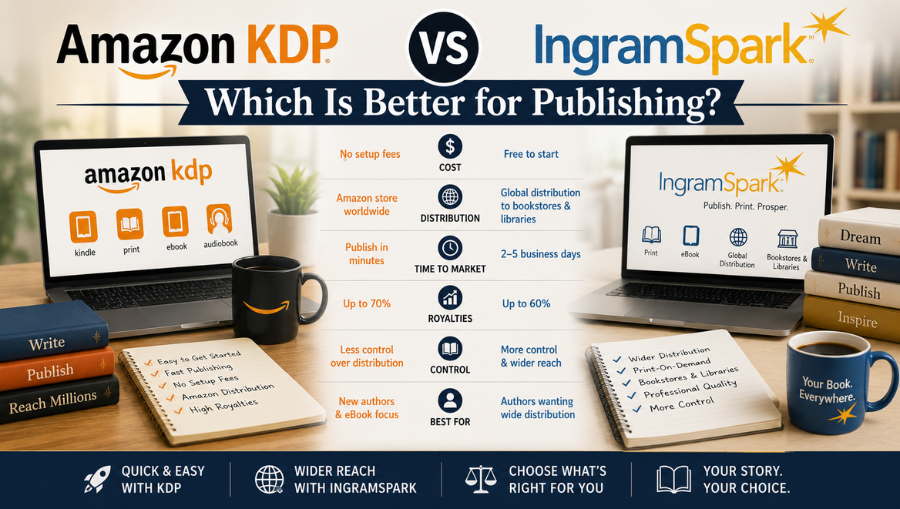
The decision to select Amazon KDP and IngramSpark is not just a matter of publication. It’s a strategic decision that decides where your book will be published, what you can expect from the platform and how it will travel among your audience.
Introduction
Your decision to select from Amazon KDP vs IngramSpark publishing platform boils down to one single fact: what is your goal of publishing? For self-publishing authors, the comparison looks easy at first. However, there’s a remarkable difference in between both the platform.
Amazon KDP is the largest online bookstore. It’s easy and convenient to use. Being its easy nature, it’s been the most popular choice for readers and authors. Whereas IngramSpark is more trade-facing, with a wider bookstore distribution feature.
This guide seeks to answer all your queries related to IngramSpark vs KDP in 2026. It also seeks to teach you writing techniques that help you decide which platform is the suitable choice for your book.
What Is Amazon KDP?
Amazon Kindle Direct Publishing, which is also known as Amazon KDP, is a self-publishing platform. It allows authors to publish and sell books in all formats. Whether it’s an ebook, paperback, or hardcover, you can leverage one of the largest Amazon databases to sell your book.
Amazon KDP is designed to work with speed, clarity and authority without the need to rely on the traditional publishing route. All you would need to do is to strictly adhere to the platform’s standards and upload your book with a pricing strategy. For many independent authors, it’s a starting point to get access into the publishing world.
Due to easy accessibility into the platform, it’s not certain whether your book would be liked by the readers. KDP accepts the file if it meets the technical requirements of the platform; however, the real judgment lies with the readers.
How Amazon KDP Works
KDP offers a print-on-demand and digital publishing model. If you’re working with an eBook, your readers can access it through Kindle devices and Kindle apps. In contrast, paperbacks and hardcovers are printed on demand. Whenever customers order them, the books are printed for them. This way, the author doesn’t have anything to do with the upfront inventory.
This is one of the strengths of KDP publishing. The author doesn’t have to pay for the unsold books, stacked in boxes forever. With Print-on-demand, Amazon deducts only the printing cost and other applicable charges from the sales of the book.
However, there’s a catch. The author has to do everything on their own. From listing, including meta content and description, to setting up the categories, prices, and territories, the author controls the parts of it. For authors who want a fast route to Amazon customers, KDP is hard to ignore.
What Types of Books Can You Publish on KDP?
KDP supports several major book types:
- Ebooks
- Paperbacks
- Hardcovers
- Low-content books, within Amazon’s content rules
- Fiction and nonfiction
- Children’s books
- Series books
- Workbooks and journals, where allowed by platform guidelines
That range makes KDP attractive to new authors. A novelist can publish an ebook and paperback. A memoirist can release a print edition. A business author can publish a Kindle ebook for lead generation. A children’s author can publish illustrated work, though picture books require careful formatting.
Still, not every book is equally easy to publish on KDP. Color-heavy books, art books, complex layouts, and premium hardcovers may face limits in format, cost, and print finish. Authors should not assume that because KDP accepts a file, it is the best home for that book.
Main Benefits of Amazon KDP for Authors
The biggest benefit of KDP is direct access to Amazon readers. For many genres, especially commercial fiction, nonfiction how-to books, romance, fantasy, thrillers, memoirs, and business books, Amazon is a major place where readers search and buy.
KDP is also beginner-friendly. The dashboard is relatively simple. The upload process is direct. The author can make changes after publication. Pricing can be adjusted. The book can be published quickly.
Other benefits include:
No need to order inventory
Easy ebook publishing
Print-on-demand paperback and hardcover options
Access to Kindle Unlimited through KDP Select
Amazon Ads integration
Useful sales reports
Control over pricing and metadata
Fast revisions compared with traditional publishing routes
For authors who want the simplest path to online sales, KDP often feels like the natural first step.
Common Limitations of Amazon KDP
KDP’s strength is also its boundary. It is deeply tied to Amazon. That means it is excellent for Amazon sales, but less ideal for authors whose main goal is bookstore distribution, library ordering, or broad trade availability.
Although KDP offers expanded distribution, self-publishing authors find their program is less effective than IngramSpark for reaching wider audiences and libraries. In addition, it is observed that bookstores are a little reluctant to order books that are tied to Amazon, since Amazon is a major competitor in the retail market.
Other limitations include:
Limited bookstore appeal
Less control over trade discounts in some distribution settings
Fewer premium print choices than some professional printers
Potential issues with cover and spine precision for certain designs
KDP Select exclusivity for ebooks if the author enrolls
Difficult to formulate distinctive identity in the crowded market.
Hence, it could be said that KDP is a powerful platform with a plethora of benefits, but it is not the complete publishing world.
What Is IngramSpark?
Just like Amazon, IngramSpark is a self-publishing platform that is connected to Ingram Content Group. It is one of the largest book distribution networks across the globe. It enables authors to publish their book whether they are novice writers or small publishers. It also offers print book publishing along with eBook publishing. What makes it distinctive is its ability to distribute books to bookstores, libraries, and online retailers.
If Amazon KDP is the front door to Amazon, IngramSpark is closer to the trade distribution hallway. It helps make books available to retailers and institutions that order through Ingram’s network. That does not mean bookstores will automatically stock the book. It means they can order it through channels they already use.
This distinction matters because availability doesn’t mean the book placement. IngramSpark makes the book available to the bookstores so that the readers can order. However, the author would still have to market the book. They would also have to outreach and offer strong production value so that stores care for it to make the investment. The book has to have potential, an undeniable factor, the unequivocal value that is hard to miss.
How IngramSpark Works
IngramSpark also works through a print-on-demand model. The authors have to upload their print-ready, publish-worthy files and set their pricing with a distribution option. It’s a plus point that authors can select wholesale discount choices as well. When the customer, retailer, library, or the bookstore place their orders, the book is printed and shipped through the IngramSpark channel.
Moreover, this platform offers paperback and hardcover formats along with eBook. However, its file requirements are strict and require a strong pricing strategy.
What Types of Books Can You Publish on IngramSpark?
IngramSpark supports many types of books:
Paperbacks
Hardcovers
Ebooks
Fiction and nonfiction
Children’s books
Poetry collections
Academic and professional books
Memoirs
Illustrated books
Books intended for bookstore or library ordering
IngramSpark is an attractive option for the author who wants their books professionally positioned in the market. Despite the platform’s complexity, authors find IngramSpark useful, especially those who care for hardcover and bookstore availability options.
However, it is not always the easiest choice for a first-time author. File preparation, pricing, return settings, and wholesale discounts need careful attention. A mistake can affect profit or ordering appeal.
Main Benefits of IngramSpark for Authors
The main benefit of IngramSpark is distribution reach. It can make a book available to bookstores, libraries, and many online retailers beyond Amazon. This is especially useful for authors who want a professional publishing footprint.
Other benefits include:
Wide print distribution
Bookstore and library ordering potential.
Professional paperback and hardcover options
More control over wholesale discount choices
Strong fit for authors with their own ISBNs
Good option for books meant to sell beyond Amazon
Useful for publishers and author-imprints building long-term catalogs
For authors who want a book to be seen as a serious trade title, IngramSpark can be a valuable tool.
Common Limitations of IngramSpark
IngramSpark can be harder to use than KDP. The setup process is more technical. Authors must pay close attention to trim size, cover templates, margins, spine width, bleed, pricing, and distribution settings.
The platform can also be less forgiving. A file that works elsewhere may be rejected if it does not meet IngramSpark’s requirements. Revisions may take more planning. Pricing choices can become confusing, especially when wholesale discounts and print costs are factored in.
Other limitations include:
Steeper learning curve
Potential setup or revision costs, depending on current policies and promotions
More complex pricing and discount decisions
Bookstore availability does not guarantee bookstore placement
Returns can create financial risk if enabled
Ebook distribution may not be as central for many authors as KDP Kindle publishing.
IngramSpark rewards authors who think like publishers. That is its strength, and for some, its burden.
Amazon KDP vs IngramSpark: Quick Comparison for 2026
The simplest answer in the Amazon KDP vs IngramSpark comparison 2026 is this: KDP is often best for Amazon sales and ease of use. IngramSpark is often best for wider print distribution, bookstore ordering, and a more trade-friendly setup.
But simple answers can mislead. The better view is category by category.
Ease of Use: kdp vs ingramspark
In the KDP vs IngramSpark ease-of-use debate, KDP usually wins. Its dashboard is more beginner-friendly. The upload steps are clearer. Authors can publish quickly and update files with relative ease.
IngramSpark is more demanding. It asks authors to make decisions that feel more like professional publishing decisions. That can be helpful, but it can also slow down a new author.
If an author wants the simplest setup, KDP is usually easier. If an author wants a more trade-facing setup and is willing to learn, IngramSpark offers more reach.
Publishing Costs
KDP usually has low upfront costs for authors. There is no required inventory purchase, and many authors can upload files without paying platform setup fees. The main costs are editing, cover design, formatting, ISBN choices, and printing costs deducted when books sell.
IngramSpark may involve more cost depending on setup choices, revisions, print proof orders, and distribution settings. Its true cost of book publishing also depends heavily on wholesale discounts and print costs.
Authors should not judge cost only by upload fees. The real cost includes design, formatting, ISBNs, proof copies, revisions, discount choices, and the time required to fix mistakes.
Print Quality
Print quality depends on the type of book you are publishing, the printer location, your choice of paper usage, and the format. Some prefer IngramSpark for printing edition others go for Amazon KDP. At the end, it falls back to the goals of the author. Nevertheless, authors should order sample copies from their desired platform before ordering large quantities. This way you can find issues in printed proof such as cover inaccuracy, tight margins, thin paper and spine. The best print platform is not theoretical. It is the one that produces a copy the author can proudly hand to a reader.
Ebook Publishing
Both platforms offer eBook publishing. KDP is the strongest choice for ebook as it provides Kindle Unlimited through KDP Select. On the other hand, IngramSpark can distribute eBooks to retailers and ebook distributors.
If you want easy and quick access into the publishing world, KDP is the best option to begin with.
Paperback and Hardcover Options
IngramSpark is a suitable option for authors who want wider and broader access to bookstore-friendly setup. This platform offers paperback and hardcover options. Their style is trade-centered with print position in the market. They can offer direct access to a multitude of bookstores, libraries, and multiple retailers. In contrast, KDP’s paperback feature is convenient and useful for Amazon customers. For hardcover, authors need to check the format and distribution carefully.
Distribution Reach
This is one of the clearest differences. KDP is strongest inside Amazon. IngramSpark is stronger for wide print distribution.
An IngramSpark vs KDP distribution comparison often comes down to this question: does the author mainly want Amazon customers, or does the author want the book available through broader bookseller and library channels?
KDP can reach Amazon powerfully. IngramSpark can help a book appear in ordering systems used by bookstores and libraries.
Royalties and Profit Margins
The comparison between Amazon KDP royalties vs IngramSpark royalties depends on price, format, print cost, territory, discount, and distribution channel. KDP may offer stronger margins for books sold directly through Amazon. IngramSpark may require higher retail pricing or careful discount choices to maintain profit through wide distribution.
A common mistake is asking which platform pays more without doing the math for the actual book. A 100-page black-and-white paperback and a 450-page color interior book are not the same business.
Authors should calculate profit by format and channel before publishing.
Bookstore and Library Availability
For bookstore and library availability, IngramSpark generally has the advantage. Bookstores and libraries commonly order through Ingram-connected systems, which makes IngramSpark a practical route for authors who want that access.
KDP’s expanded distribution can make books available beyond Amazon, but many authors use IngramSpark when bookstore and library access is a serious goal.
Still, availability is only the first step. A bookstore can order the book. That does not mean it will stock it without demand, outreach, a strong cover, proper pricing, and often returnability.
Author Control and Ownership
Both platforms allow authors to retain rights to their work. The author is not handing over copyright by publishing through KDP or IngramSpark.
However, ISBN choices matter. If an author uses a free ISBN from a platform, that platform may be listed as the publisher of record for that edition. Authors who want a more professional imprint identity often purchase their own ISBNs and use them strategically.
Control is not only about legal rights. It is also about metadata, pricing, files, distribution choices, and long-term flexibility.
Amazon KDP: Pros and Cons
KDP is often the author’s first platform because it feels direct. That directness is valuable. It can also hide the need for a wider strategy.
Pros of Amazon KDP
KDP is easy to use. It offers direct access to Amazon. It supports ebooks, paperbacks, and hardcovers. It requires no inventory. It lets authors change pricing, update files, and track sales.
Key pros include:
Fast setup
Strong Amazon marketplace reach
Good choice for Kindle ebooks
Print-on-demand convenience
No required inventory
Beginner-friendly dashboard
Access to Amazon Ads
Potential Kindle Unlimited enrollment
Useful for testing a book quickly
For authors writing commercial genres, KDP can be a serious sales engine.
Cons of Amazon KDP
KDP’s limitations appear when the author wants to move beyond Amazon. Bookstore access is weaker. Some retailers may not be eager to stock Amazon-associated editions. Expanded distribution may not provide the same trade reach as IngramSpark.
Other cons include:
Less ideal for bookstore-first strategies
Possible exclusivity restrictions if using KDP Select for ebooks
Print options may not suit every book
Amazon marketplace competition is intense
Success often requires metadata, ads, reviews, and ongoing promotion
KDP is simple to enter, but not simple to master.
Who Should Use Amazon KDP?
KDP is often a strong fit for:
First-time authors
Ebook-focused authors
Authors selling mainly through Amazon
Genre fiction writers
Nonfiction authors with clear search demand
Authors testing a book before wider distribution
Authors who want a simple print-on-demand paperback
If the question is, should I publish on Amazon KDP or IngramSpark, and the author is publishing a first ebook with limited budget and no bookstore plan, KDP is often the practical starting point.
IngramSpark: Pros and Cons
IngramSpark is not always the easiest platform, but it is often the more serious choice for authors who care about print distribution beyond Amazon.
Pros of IngramSpark
IngramSpark offers wide distribution, bookstore and library ordering potential, and professional print options. It is especially useful for authors who want their book listed through channels booksellers already use.
Key pros include:
Wide distribution reach
Bookstore and library ordering access
Professional paperback and hardcover options
Better fit for author-owned ISBNs and imprints
Useful for serious print publishing strategies
Good for authors who want sales beyond Amazon
Strong long-term catalog potential
IngramSpark is often less about instant simplicity and more about publishing infrastructure.
Cons of IngramSpark
The platform has a steeper learning curve. File requirements can be strict. Pricing decisions are more complex. Authors need to understand wholesale discounts and returns before choosing settings.
Common cons include:
More technical setup
Possible revision or setup costs depending on current terms
More complex profit calculations
No guarantee of bookstore stocking
Potential return risks if returns are enabled
Can feel intimidating for beginners
Who Should Use IngramSpark?
IngramSpark is often a strong fit for:
Authors who want bookstore access
Authors who want library ordering potential
Authors with their own ISBNs
Authors publishing under a serious imprint
Authors selling print books outside Amazon
Authors with a long-term catalog plan
Authors who want broader retail distribution
If the book is meant to live beyond Amazon, IngramSpark deserves close attention.
Which Platform Is Better for Ebook Publishing?
For many authors, KDP is the stronger choice for ebooks. Kindle remains central to the ebook market, and KDP makes Kindle publishing simple.
Why Many Authors Choose KDP for Ebooks
KDP gives authors direct access to Kindle readers. The upload process is fairly simple. Authors can choose pricing, update files, and run promotions in certain programs.
KDP Select can also place ebooks in Kindle Unlimited, which may help some genres, especially romance, fantasy, thrillers, and series fiction. But KDP Select requires exclusivity for the ebook during the enrollment period, meaning the ebook cannot be sold elsewhere while enrolled.
That tradeoff matters. Kindle Unlimited can be useful, but it is not right for every author.
When IngramSpark May Work for Ebook Distribution
IngramSpark can distribute ebooks to multiple retailers, which may interest authors who want a wide ebook presence. However, many authors prefer to use KDP for Amazon and other ebook aggregators or direct platforms for non-Amazon retailers.
IngramSpark ebook distribution may be convenient for authors who want fewer dashboards, but convenience should be weighed against control, pricing flexibility, and retailer-specific tools.
Best Option for New Authors Publishing an Ebook
For most new authors publishing an ebook, KDP is the easiest first step. It is direct, visible, and widely used.
But authors should think carefully before enrolling in KDP Select. If they want the ebook available on Apple Books, Kobo, Barnes & Noble, Google Play, or other retailers, they should avoid exclusivity.
The best choice depends on whether the author wants Amazon-only ebook focus or wide ebook distribution.
Which Platform Is Better for Print Books?
Print books require a different kind of thinking. The file is physical. The margin matters. The spine matters. The paper matters. The distribution channel matters.
KDP for Paperback and Hardcover Publishing
KDP is a strong option for paperbacks and some hardcovers sold through Amazon. It is simple and efficient. For many authors, a KDP paperback is enough for reader demand.
It works well when:
Most sales happen on Amazon
The book is black-and-white text
The author wants easy print-on-demand
The author does not need bookstore distribution
The author wants a low-friction setup.
KDP print can be a practical, smart choice. It just should not be confused with a full bookstore distribution plan.
IngramSpark for Print-on-Demand Distribution
IngramSpark shines when print distribution matters beyond Amazon. It can make a book available through systems used by bookstores, libraries, and online retailers.
It works well when:
The author wants bookstore ordering access
The author wants library potential
The author owns ISBNs
The book has professional cover and interior design
The author is prepared to set discounts carefully
The author has a plan to create demand outside Amazon
IngramSpark is not automatically better for every print book. It is better when the author needs what it offers.
Best Option for Authors Selling Print Books
For authors selling mostly on Amazon, KDP may be the better print choice. For authors selling through bookstores, events, schools, libraries, or direct outreach, IngramSpark may be better.
For many serious authors, the answer is both: KDP for Amazon, IngramSpark for wider print distribution.
Which Platform Is Better for Bookstore Distribution?
Bookstore distribution is one of the most misunderstood parts of self-publishing. Authors often think “available to bookstores” means “stocked in bookstores.” It does not.
How KDP Expanded Distribution Works
KDP expanded distribution can make a paperback available to certain retailers and distributors outside Amazon. This sounds attractive, but it may not be the strongest route for bookstore placement.
Some bookstores may be less inclined to order Amazon-published editions. Also, expanded distribution may offer less control than IngramSpark for wholesale discount and trade-facing settings.
KDP expanded distribution can help, but it is not usually the first choice for authors who care deeply about independent bookstores.
How IngramSpark Global Distribution Works
IngramSpark connects to Ingram’s global distribution network, which many bookstores and libraries already use. This can make ordering easier and more familiar for booksellers.
But the author still needs:
A professional cover
A strong book description
An appropriate retail price
A wholesale discount that makes sense
A marketing plan that creates demand
A reason for stores or libraries to order
IngramSpark opens a gate. It does not push the book through it.
Best Option for Authors Who Want Bookstore Access
For bookstore access, IngramSpark is generally the stronger choice. Authors who want bookstore availability should use their own ISBN, prepare professional files, choose pricing carefully, and understand wholesale discount and return settings.
Bookstores are businesses. They need books that fit their customers and their shelves. Distribution is only part of the conversation.
Which Platform Is Better for Royalties and Profit?
Profit is where vague advice becomes dangerous. No platform is always “higher paying” in every case.
Amazon KDP Royalty Considerations
KDP royalties vary by format, territory, price, delivery costs for ebooks in some royalty structures, and printing costs for print books. For ebooks sold through Amazon, KDP can offer attractive royalty options depending on price and territory.
For print books, Amazon deducts printing costs from the sale before calculating author earnings. A short black-and-white paperback may have a healthy margin. A long book or color book may have a much tighter margin.
Authors should run the numbers before setting a price.
IngramSpark Royalty Considerations
IngramSpark earnings depend on retail price, print cost, wholesale discount, and distribution choices. The wholesale discount is especially important because bookstores and retailers expect room to make money.
If the author sets a high discount, the book may be more appealing to retailers but less profitable per copy. If the discount is low, the author may earn more per sale but reduce bookstore interest.
This is the central tension of IngramSpark: reach often requires margin.
How Printing Costs Affect Author Profit
Printing cost is not just a technical detail. It shapes the book’s entire business model.
Factors that affect print cost include:
Page count
Trim size
Black-and-white vs color interior
Paperback vs hardcover
Paper type
Binding type
Printer location and distribution channel
A 650-page novel and a 180-page guide have very different economics. Before publishing, authors should test several prices and formats to see whether the profit makes sense.
How Retail Discounts Affect Book Earnings
Retail discounts matter most in wide distribution. Bookstores usually expect a wholesale discount so they can make a profit when selling the book.
A higher discount may improve ordering appeal but reduce the author’s earnings. A lower discount may protect earnings but reduce retail interest.
Authors should not choose discount settings casually. This decision affects both access and profit.
Can You Use Amazon KDP and IngramSpark Together?
Yes, many authors use both Amazon KDP and IngramSpark together. This hybrid approach is often the most balanced option.
Why Some Authors Use Both Platforms
Authors often use KDP for Amazon sales and IngramSpark for wider print distribution. This allows them to take advantage of Amazon’s direct marketplace while also making the book available through Ingram’s network.
This approach can be especially useful for authors who want:
Strong Amazon sales
Bookstore ordering access
Library availability
Direct sales options
Professional imprint positioning
Long-term distribution flexibility
The key is setting up ISBNs and distribution choices correctly.
When to Use KDP for Amazon Sales
Use KDP for Amazon sales when you want the book to appear smoothly on Amazon and take advantage of Amazon’s customer base. Many authors upload the ebook and print edition directly to KDP for this reason.
For ebooks, KDP is often the simplest route to Kindle readers. For paperbacks, KDP can keep Amazon availability direct and efficient.
When to Use IngramSpark for Wider Distribution
Use IngramSpark when you want print distribution beyond Amazon. This includes bookstores, libraries, schools, independent shops, and online retailers that order through Ingram-connected systems.
Authors who do events, speaking engagements, school visits, library outreach, or bookstore pitching may benefit from IngramSpark’s wider reach.
Important ISBN Considerations Before Using Both
ISBN setup is critical when using both platforms.
If you use your own ISBN, you have more control over publisher identity. If you use a free platform-provided ISBN, that platform may be listed as publisher of record for that edition, and the ISBN may not be usable on another platform.
In general, authors who plan to use both KDP and IngramSpark should consider purchasing their own ISBNs before publishing. This helps avoid confusion and supports a more professional publishing setup.
The same format cannot usually use two different ISBNs across platforms if it is meant to be the same edition. Authors should plan carefully before uploading.
Amazon KDP vs IngramSpark for New Authors
New authors often need two things at once: simplicity and a future. KDP offers simplicity. IngramSpark offers broader future reach. The best choice depends on goals.
Best Choice for First-Time Authors
For first-time authors, KDP is usually easier. It has fewer barriers, a simpler dashboard, and direct access to Amazon. A new author can learn publishing basics without immediately managing trade distribution settings.
Still, first-time authors should not rush. They should prepare professional files, write a strong book description, choose categories carefully, and order proofs.
Best Choice for Authors on a Budget
For authors on a tight budget, KDP is often the lower-friction choice because upfront platform costs can be minimal. But “budget” should not mean careless.
Even if the upload is free, the author should still budget for editing, cover design, formatting, and proof copies. A poorly prepared book can cost more in lost trust than it saves in production.
Best Choice for Authors Who Want Global Distribution
For broad print distribution, IngramSpark is often stronger. It is designed to make books available through a wide network of retailers and libraries.
However, global availability does not guarantee global sales. The author still needs marketing and demand.
Best Choice for Authors Who Want Bookstore Availability
For bookstore availability, IngramSpark is usually the better choice. Bookstores are more familiar with Ingram ordering systems than with Amazon-centered self-publishing routes.
Authors should also understand that bookstores care about professional presentation, local relevance, demand, and returnability. IngramSpark can help with access, not persuasion.
Best Choice for Authors Who Want the Simplest Setup
For the simplest setup, KDP usually wins. It is more approachable for beginners and faster to learn.
If an author’s first goal is to publish a Kindle ebook and Amazon paperback, KDP is often the cleanest starting point.
Common Mistakes Authors Make When Choosing KDP or IngramSpark
The wrong platform choice is rarely fatal, but it can create delays, duplicate work, and avoidable costs.
Choosing Based Only on Cost
The cheapest upload is not always the cheapest publishing path. A platform that saves money upfront may limit distribution. A platform with wider reach may require more careful pricing.
Authors should compare total cost, not just setup cost.
Ignoring Distribution Goals
Some authors say they want bookstores, but publish only through a path that makes bookstore ordering harder. Others pay for wide distribution when all their sales will likely happen on Amazon.
The platform should match the sales plan.
Using the Wrong ISBN Setup
ISBN mistakes are common. Authors should decide early whether they want to use free platform ISBNs or buy their own.
For authors building a long-term brand or imprint, owning ISBNs often provides cleaner control.
Forgetting About Print Quality and Formatting Requirements
A manuscript file is not the same as a print-ready book file. Each platform has rules. Margins, bleed, cover size, spine width, fonts, and image resolution matter.
Authors should not wait until launch week to solve formatting problems.
Expecting Automatic Bookstore Sales
IngramSpark can make a book available to bookstores. It does not make bookstores stock it. KDP can list a book on Amazon. It does not make readers buy it.
Distribution is infrastructure. Marketing creates movement.
Amazon KDP vs IngramSpark: Final Verdict
The final verdict is not one-size-fits-all. The smarter answer is conditional.
Choose Amazon KDP If…
Choose Amazon KDP if:
You are a first-time author who wants the simplest setup
You want to publish a Kindle ebook
Most of your readers buy on Amazon
You want easy print-on-demand for Amazon sales
You are testing your book before expanding
You want access to Kindle Unlimited
You do not need bookstore distribution right away
KDP is strong, direct, and practical.
Choose IngramSpark If…
Choose IngramSpark if:
You want bookstore ordering access
You want library distribution potential
You own your ISBNs
You care about broader print distribution
You plan to sell through events, schools, shops, or direct outreach.
You want a professional trade-style setup
You are prepared to manage pricing, discounts, and file requirements
IngramSpark is wider, more complex, and often better for long-term print reach.
Use Both Platforms If…
Use both platforms if:
You want Amazon sales through KDP
You want wider print distribution through IngramSpark.
You have your ISBNs planned correctly
You understand distribution settings
You want both ease and reach
You are building a serious author brand or publishing imprint
For many authors, the best answer to which platform is better for self-publishing a book is not KDP or IngramSpark. It is KDP and IngramSpark, used wisely.
Conclusion
The question of which is better Amazon KDP or ingramspark sounds like a duel, but publishing is rarely that clean. KDP is the bright front window on the busiest online street. IngramSpark is the trade route behind the shopfronts, the one that lets books move through bookstores, libraries, and wider retail systems. One is not morally better than the other. They serve different kinds of movement.
For new authors, the final recommendation is simple: start with the reader, not the platform. If the book’s natural home is Amazon, begin with KDP. If the book needs bookstore and library access, study IngramSpark carefully. If the author wants both strong Amazon presence and wide print reach, use both with a clean ISBN plan.
A finished book deserves more than a rushed upload. It deserves a route. And the best route is the one that carries the book toward the readers most likely to care.
The upload screen can make publishing feel like a single click, but a book’s life is longer than that click. It travels through choices: ISBNs, formats, retailers, discounts, proofs, readers, and time. For authors who want help choosing the right route, preparing professional files, and building a publishing path that fits the book’s real future, Blue Mount Publishers offers Affordable Book Publishing Solutions designed to guide writers from finished manuscript to finished book with care, clarity, and fewer wrong turns.
FAQs About Amazon KDP vs IngramSpark
What is the main difference between Amazon KDP and IngramSpark?
The main difference between Amazon KDP and IngramSpark is distribution focus. Amazon KDP is best known for direct publishing to Amazon, especially Kindle ebooks and Amazon print-on-demand paperbacks. IngramSpark is built more for wide print distribution, including access to bookstores, libraries, and online retailers connected to Ingram’s network. KDP is usually easier for beginners and stronger for Amazon sales. IngramSpark is more complex but often better for authors who want broader print availability. The right choice depends on whether your main goal is Amazon reach, bookstore access, or both.
Which is better for beginners, Amazon KDP or IngramSpark?
Amazon KDP is usually better for beginners because the platform is easier to use, the setup process is more direct, and the connection to Amazon readers is clear. A first-time author can publish an ebook and paperback without learning every detail of bookstore distribution. That said, beginners should still prepare professional files, write a strong description, and order proof copies. IngramSpark can be useful for beginners who already know they want bookstore or library access, but it requires more care with ISBNs, file setup, pricing, and wholesale discounts. For most first books, KDP is the simpler starting point.
Can I use both Amazon KDP and IngramSpark together?
Yes, many authors use both Amazon KDP and IngramSpark together. A common strategy is to use KDP for Amazon sales and Kindle ebooks, while using IngramSpark for wider print distribution to bookstores, libraries, and other retailers. This can give the author the best of both systems. The main caution is ISBN planning. If you use a free ISBN from one platform, it may not work the way you want on another platform. Authors who plan to use both often benefit from purchasing their own ISBNs and setting up each edition carefully before publication.
Which platform gives higher royalties, KDP or IngramSpark?
KDP often provides better margins for books sold directly through Amazon, especially ebooks and some print books. IngramSpark royalties depend heavily on print cost, retail price, wholesale discount, and distribution channel. If you set a high wholesale discount to make the book more attractive to bookstores, your per-copy earnings may be lower. That does not mean IngramSpark is worse; it means it serves a different distribution purpose. Authors should not guess. They should calculate profit for each format and channel before publishing. The platform with “higher royalties” depends on the book’s price, page count, format, and sales path.
Does IngramSpark distribute to bookstores?
Yes, IngramSpark can make books available through Ingram’s distribution network, which many bookstores use to order books. This is one of the main reasons authors choose IngramSpark. However, availability does not mean automatic bookstore placement. A bookstore may be able to order the book, but it will not necessarily stock it unless there is demand, local interest, strong presentation, and a sensible wholesale discount. Authors who want bookstore sales still need outreach, marketing, professional cover design, and a clear reason for stores to carry the book. IngramSpark provides access, but the author must help create demand.
Which platform is better for long-term book sales?
For long-term book sales, many authors benefit from using both platforms strategically. KDP can support strong Amazon sales, Kindle ebooks, Amazon ads, and print-on-demand orders through Amazon. IngramSpark can support wider print availability, including bookstores, libraries, and other retailers. If an author only wants Amazon sales, KDP may be enough. If an author wants a broader publishing footprint, IngramSpark adds value. Long-term success depends less on the platform alone and more on professional production, strong metadata, ongoing marketing, reader reviews, and future books. The platform is the road, not the engine.