
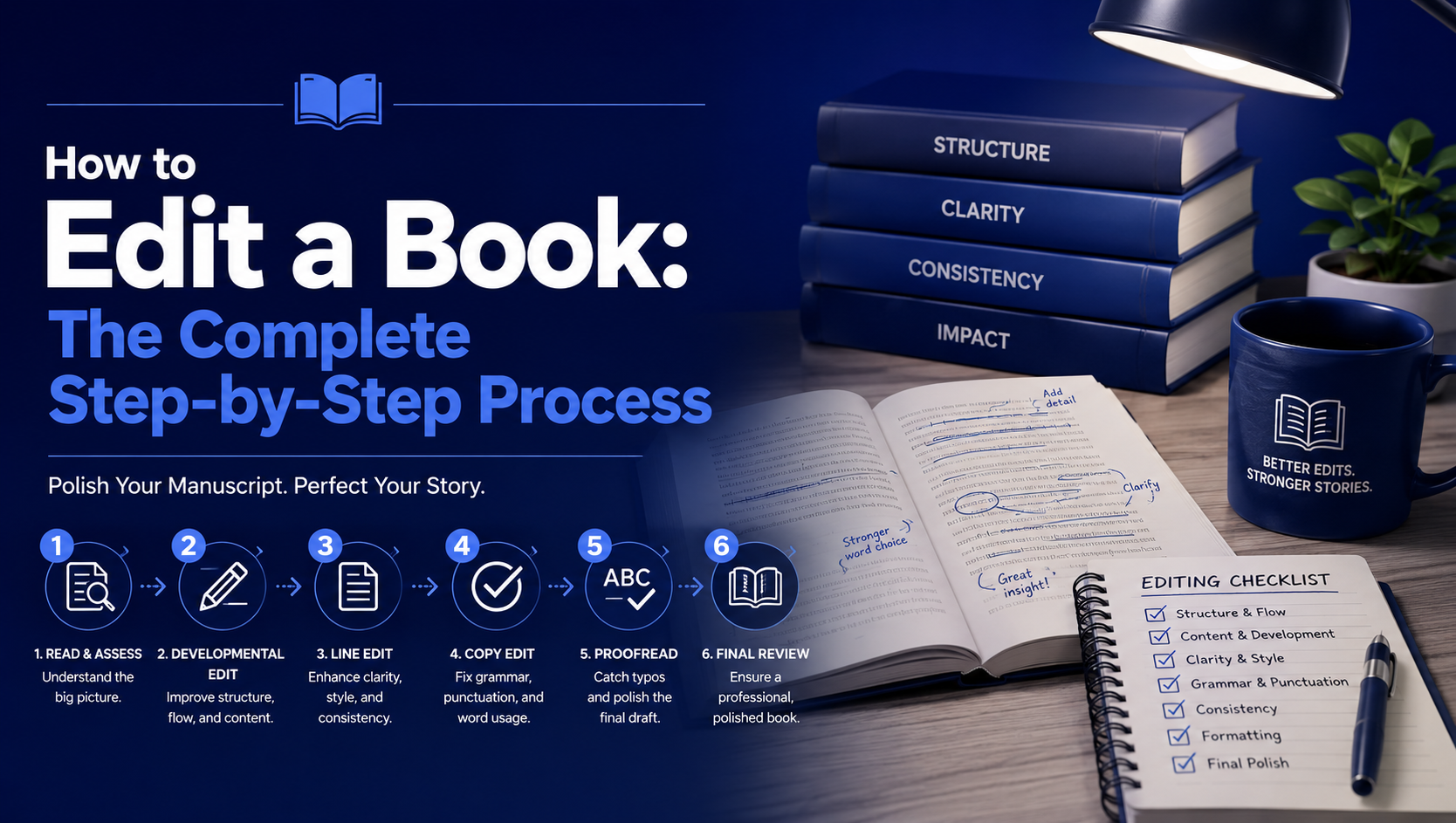
Your finished draft is not the end of the writing process. It’s only half of the work. The real work begins during the editing process. Your story may have the substance, but it will miss its mark if you don’t edit a book. Your chapters can feel slow, you lose the impact, and most importantly, your book misses its physical and emotional appeal.
That is why editing is both practical and emotional. It asks the author to protect the heart of the book while cutting what gets in the way.
In this blog, we laid out the complete book editing process so that you can edit your own book without depending on anyone. We have also laid out all the ins and outs of the editing process if you decide to hire a professional book editor. Follow our book editing checklist before you consider your draft as the final file.
What Does “Editing a Book” Actually Mean?
Editing a book means that you assess your manuscript and check it on different levels. From small punctuation marks to big-picture editing, your manuscript passes through different stages in order to be called complete.
First, the editor looks at the structure. Then the flow. Then the sentence level. Then the technical details. Then the final proof.
That is why the book editing process must be done in the right order.
The 4 Stages of Book Editing
Most books move through four main stages of editing.
The first stage is developmental editing. This structural editing refines the plot, pacing, character arc, conflict, the scenes and the overall emotional flow. If you’re working with non-fiction, book editing is done to improve the chapter organization, structure, argument, reader value, and clarity.
Once the developmental editing is done, we move to line-by-line editing. This editing type strives to improve the voice, the flow and sentence structure. It also helps avoid repetition and transition errors.
The third stage is copyediting, which checks and corrects language mistakes, grammatical errors, punctuation mistakes, consistency issues, and style choices. It helps catch small errors that make your book look carelessly written.
The fourth and final stage is proofreading. Usually, it is done after the formatting has been applied to the manuscript. Proofreading helps in finding all the sneaky errors that escape in the earlier editing process. Some of the proofreading tasks are page number correction, solving layout and spacing issues, and correcting missing words. These mistakes are too serious to be corrected before publication.
Why Authors Underestimate How Much Editing a Book Requires
Authors are almost always too emotionally attached to their work. This happens because when writing, they think too closely about everything and are aware of the story behind the page. They know the characters’ motives, they know the deleted scenes, and they understand the situation’s gravity. That is why they can miss writing errors. Readers only know the words on the page, and they are judging the work based on that knowledge only.
Authors can miss writing aspects, such as:
- A slow opening
- A weak ending
- Repeated ideas
- Confusing timelines
- Flat dialogue
- Characters who change too quickly
- Nonfiction chapters that repeat the same point
- Unclear examples
- Overused words
- Missing transitions
- Grammar patterns the author does not notice
Editing also takes time because every change affects something else. Cutting one chapter may require new transitions. Changing a character’s decision may affect later scenes. Moving a nonfiction section may require new context. Fixing one sentence may reveal that the whole paragraph needs work.
Good editing is not only correction. It is careful rebuilding.
The Book Editing Process, Step by Step
The best way to edit a Book is to move from large issues to small ones. Do not start by polishing every comma if the whole chapter may need to be cut later. Start big. Then move smaller.
This step-by-step book editing process gives authors a clear path.
Step 1 — Let the Manuscript Rest Before You Start
Before editing, give the manuscript time to rest. You may think it’s common advice, but it is one of the most important tips for book editing that you shouldn’t miss.
After finishing a draft, the author is usually too close to the work. Every scene still carries the memory of the effort it took to write. The writer may defend weak pages because they were hard to create. Time creates distance.
Let the manuscript rest for at least one to two weeks if possible. For longer books, a month can be even better. During this break, do not keep rereading the same scenes. Let the book become slightly unfamiliar.
When you return, you will see more clearly. Slow chapters will feel slow. Repeated words will stand out. Weak arguments will feel weaker. Strong scenes will still hold. If you can’t let your manuscript cure for a few weeks, a few days would work too.
The goal is to give a fresh pair of eyes and mind.
Step 2 — Do a Developmental Read-through
The developmental read-through is the first serious editing pass. It checks the whole book, not the small errors.
For fiction, ask:
- Does the story begin in the right place?
- Does every chapter move the story forward?
- Is the main character’s goal clear?
- Does the conflict grow?
- Are there plot holes?
- Do the emotional changes feel believable?
- Is the pacing too slow or too rushed?
- Does the ending feel earned?
For nonfiction, ask:
- Is the main promise clear?
- Does each chapter support that promise?
- Is the order logical?
- Are examples strong enough?
- Is any section repeated?
- Does the reader know what to do next?
- Are claims supported?
- Does the book solve the problem it promises to solve?
Step 3 — Line Edit for Voice, Clarity, and Flow
After the structure is strong, move to line editing. These stages help you make the language sharper.
When you’re editing, make sure that you look for the errors mentioned below.
- Sentences that are hard to follow
- Words or sentences that are repeated
- Confusing pronouns
- Awkward transitions
- Flat descriptions
- Dialogue that sounds unnatural
- Paragraphs that go on too long
- Scenes with too much explanation
- Nonfiction sections that feel too abstract
Step 4 — Copyedit for Grammar, Consistency, and Style
Copyediting is the technical stage. It checks the book for correctness and consistency.
This includes:
- Grammar
- Spelling
- Punctuation
- Capitalization
- Hyphenation
- Tense consistency
- Point of view consistency
- Character names
- Place names
- Numbers
- Dates
- Style choices
- Repeated words
- Sentence errors
- Formatting consistency
For nonfiction, copyediting may also check:
- Citations
- Source formatting
- Footnotes
- Endnotes
- Tables
- Captions
- Terminology
- Fact consistency
Copyediting is especially important for editing a book for self-publishing because the author is responsible for quality. There is no traditional publishing team checking the manuscript unless the author hires one.
A copyeditor may create a style sheet. This is a document that records choices for the book. For example, it may note whether the book uses “email” or “e-mail,” whether numbers are written as words or digits, and how character names are spelled.
This helps keep the whole book consistent.
Step 5 — Proofread as the Final Pass
Proofreading is the last editing stage. It happens after the book has been formatted for print or ebook.
Proofreading is not the time to rewrite whole chapters. It is the time to catch final mistakes.
A proofreader checks:
- Typos
- Missing words
- Extra words
- Wrong page numbers
- Bad line breaks
- Spacing issues
- Chapter heading errors
- Table of contents errors
- Widows and orphans
- Incorrect headers or footers
- Formatting problems
- Small punctuation mistakes
Proofreading matters because formatting can create new errors. A chapter title may shift. A page number may disappear. A line may break strangely. An image may move. An ebook link may fail.
Never skip the final proofread. Many authors do, and readers notice.
Book Editing Checklist (Self-Editing Your Work)
A book editing checklist helps authors stay organized. It keeps the editing process from becoming a vague feeling of “make it better.”
Use this checklist when editing their work before sending it to a professional editor or publishing the book.
Structural Checklist (Plot Holes, Pacing, Character Arcs)
For fiction, check:
- Story beginning
- Clarity in the main characters’ goals
- Is the conflict strong enough?
- How does each chapter move the story forward
- Is there repetition of ideas
- Is the emotional appeal of the plot constant
- Do characters feel believable?
- Are character arcs clear?
- Are there plot holes?
- Are any chapters too slow?
- Are any important moments rushed?
For nonfiction, check:
- Is the main promise clear?
- Is why the book matters clear?
- Does each chapter serve the reader?
- Is the chapter order logical?
- Are ideas repeated too often?
- Are examples specific?
- Are claims supported?
- Does each chapter end with clarity?
- Does the book build from simple ideas to deeper ones?
- Does the conclusion feel useful?
In our experience, structural editing is found to be the most important stage for your book. If the structure isn’t aligned properly, the line edits will only create more confusion and chaos.
Line-level Checklist (Repetition, Tense Consistency)
At the line level, check:
- Are sentences clear?
- Are paragraphs too long?
- Are the same words repeated too often?
- Does the writing sound natural?
- Are transitions smooth?
- Is the tone consistent?
- Is the point of view steady?
- Is the tense consistent?
- Is dialogue believable?
- Are descriptions specific?
- Are there too many filler words?
- Are there weak phrases such as “very,” “really,” “just,” and “somewhat”?
- Are there sentences that can be shorter?
Read the work aloud. This is one of the best tips for book editing. The ear catches problems the eye misses. If you stumble while reading, the sentence may need work.
Technical Checklist (Grammar, Formatting, Citations for Nonfiction)
For technical editing, check:
- Spelling
- Grammar
- Punctuation
- Commas
- Quotation marks
- Capitalization
- Hyphenation
- Numbers
- Dates
- Names
- Locations
- Chapter titles
- Headers
- Footers
- Page numbers
- Table of contents
- Footnotes
- Endnotes
- Citations
- Bibliography
- Image captions
- Formatting consistency
If you’re working with non-fiction, you have to ensure that all the data is sourced from accurate and authentic sites. If your work includes historical facts, quotes, or studies, then it should be fact-checked carefully. Technical errors can make your work weak. Likewise, your readers would lose their trust in you.
Should You Edit Your Own Book or Hire a Professional Editor?
Whether you should edit your own book or hire an expert is a legitimate concern. Self-editing is necessary. Professional editing is often wise.
As an author, you may need to revise your manuscript before sending it forward to the editor. This will help you save time and avoid constant back and forth, along with costs. It also helps the editor focus on deeper problems instead of issues the author could have fixed first.
But self-editing has limits. The author is too close to the work to see everything.
What Self-editing Can Realistically Catch
- Obvious plot holes
- Slow scenes
- Repeated ideas
- Weak chapter openings
- Basic grammar mistakes
- Word repetition
- Awkward sentences
- Unclear paragraphs
- Missing transitions
- Inconsistent formatting
- Overwritten sections
- Unneeded scenes
Self-editing is also useful because it teaches the author about their own habits. Some writers over-explain. Some repeat the same emotion. Some start too many sentences the same way. Some use long paragraphs. Some avoid conflict. Some rush endings.
When authors learn these patterns, they become stronger writers.
What Professional Editors Catch That Authors Usually Miss
Professional editors bring distance, training, and experience. They do not see the book as the author intended. They see the book as the reader will receive it.
A professional editor may catch:
- A weak opening hook
- Missing character motivation
- Flat emotional stakes
- Confusing timelines
- Repetition across chapters
- Tone problems
- Genre mismatch
- Pacing issues
- Unclear arguments
- Overloaded nonfiction chapters
- Inconsistent style
- Grammar patterns
- Dialogue problems
- Reader confusion
- Publishing-market concerns
Professional editors, due to their years of experience, know how to give feedback. They hold the editorial expertise, and hence, are able to edit the work without damaging the author’s voice. They know that their work is not to hijack the author’s work, but rather help them make it better.
Signs It’s Time to Hire an Editor
There are several signs that are hard to ignore. You should be aware of these signs so that you can save your time and effort.
- You have revised the book several times but feel stuck.
- Beta readers are confused by the same sections.
- The book feels too long, but you do not know what to cut.
- You are opting for self-publishing
- You want professional appearance
- You are receiving mixed feedback and need expert direction.
- You struggle with grammar or sentence flow.
- You are publishing nonfiction with citations or complex ideas.
- You just want a final set of eyes before you hit publish
Editing a book for self-publishing is an integral step that you can’t miss. It is the smartest investment you’d make to make your book publishing-ready.
How Much Does Professional Book Editing Cost?
Professional editing costs vary. It depends on several factors such as length, experience, estimated delivery time, amount of work required, and the manuscript’s overall needs.
An author who treats editing as an investment knows that quality work goes a long way. Once your book is out, it becomes a part of your identity. An identity through which people remember you and recall you. It’s an experience, a long-term reputation alignment.
Typical Cost Ranges by Editing Type
Here are general cost ranges authors may see in the market:
Developmental editing costs more as it is fixing the foundation of the book. Whether it is fiction or non-fiction, if the foundation is constructed right, everything else seems to flow. Since. The developmental editing goal is to improve the structure; it is priced accordingly. Professional editors may charge you on the basis of words or a complete project.
Same goes for line editing. It is more costly than copyediting and proofreading. The more the work is required to fix the errors, the costlier it becomes.
Copyediting is priced somewhere in the middle. At the same time, proofreading is the least expensive of all three.
In other words, the time taken to complete the work and the quality of deep work define the cost of the editing.
As an author, you should ask for a written quote before hiring any editor for your book. Once they pitch you the exact quote, they are bound to work without putting on the extra cost on you.
What Affects the Price of Editing a Book
Several things can affect the price of editing a book:
- Word count
- Genre
- Editing type
- Writing quality
- Deadline
- Formatting condition
- Research or citation needs
- Number of revision rounds
- Editor experience
- Special subject knowledge
Your 50,000-word clean novel will cost less than a 50,000-word memoir with timeline issues. Similarly, if your manuscript needs heavy research, then the cost will go up as compared to writing a personal essay.
The truth is that you don’t need a cheap editor to keep your manuscript in budget. You’re going to spend a lot if you hire a cheap editor just to cut corners. At the same time, the most expensive editor is not always the right fit. Authors should compare skill, samples, communication, and experience.
How to Choose a Book Editor or Editing Service
Choosing the right editor is a serious decision. The editor will work closely with the author’s voice, structure, and ideas. The author needs someone skilled, honest, and respectful.
A good editor does not make the author feel small. A good editor helps the author see the book more clearly.
Questions to Ask Before Hiring an Editor
Before hiring an editor, ask:
- What type of editing do you provide?
- Have you edited books in my genre?
- Can I see samples or testimonials?
- Do you offer a sample edit?
- How do you give feedback?
- Do you use tracked changes?
- Do you provide an editorial letter?
- How long will the edit take?
- How do you price your work?
- What is included in the fee?
- Are revision rounds included?
- Do you follow a style guide?
- Will you create a style sheet?
- Do you offer proofreading after formatting?
The answers will show whether the editor understands the work.
Red Flags to Avoid
Be careful if an editor or editing service:
- Promises perfect sales after editing
- Refuses to explain the editing level
- Has no samples
- Has no clear pricing
- Rushes the author to pay
- Gives only vague feedback
- Changes the author’s voice too much
- Does not understand the genre
- Avoids written agreements
- Claims one quick proofread can fix a rough manuscript
- Does not communicate clearly
Editing requires trust. If the communication feels poor before payment, it may not improve later.
Why Working With a Publisher-backed Editing Team Like Blue Mount Publisher Reduces Risk
Working with a publisher-backed editing team can reduce risk because the author is not hiring a random freelancer without support. A publishing team often understands more than grammar. It understands how editing connects to design, formatting, printing, distribution, and reader expectations.
A team like Blue Mount Publisher can help authors move through the full publishing path with more structure. The manuscript can be reviewed not only as a document, but as a future book. That matters because editing for publication is different from editing for personal use.
A publisher-backed team can help with:
- Developmental feedback
- Line editing
- Copyediting
- Proofreading
- Style consistency
- Book formatting concerns
- Genre expectations
- Publishing readiness
- Self-publishing quality standards
- Final proof checks
This can be especially useful for first-time authors. Instead of guessing what the book needs, the author can get guided support.
Tips for Book Editing
The best tips for book editing are simple, but they require discipline.
- Let the manuscript rest before editing.
- Edit in stages, not all at once.
- Start with structure before grammar.
- Read the book aloud.
- Print pages if possible.
- Keep a list of repeated words.
- Use a style sheet.
- Check one issue at a time.
- Ask beta readers clear questions.
- Do not accept every suggestion blindly.
- Do not ignore repeated feedback.
- Proofread after formatting.
- Save backup copies before major edits.
One of the strongest methods is to do focused passes. Do not try to fix everything in one reading. One pass can check plot. Another can check pacing. Another can check dialogue. Another can check grammar. This helps the author stay organized.
Editing is not a race. It is a process of making the book easier for the reader to enter and trust.
Editing a Book for Self-Publishing
Editing a book for self-publishing is especially important because the author is acting as the publisher. There is no traditional house standing between the book and the public. The author must make sure the book is ready.
Self-published books compete with traditionally published books on the same online pages. Readers may not care how the book was published. They care whether it reads well, looks professional, and gives them a good experience.
Before self-publishing, the author should complete:
- Developmental edit
- Line edit
- Copyedit
- Proofread
- Formatting check
- Print proof review
- Ebook test
- Cover proof
- Metadata check
- Final file review
Skipping editing to save money can cost more later through poor reviews, low sales, and damaged trust.
A self-published author does not need a perfect book. No book is perfect. But the book must feel professional, careful, and ready.
Conclusion
To edit a Book is to move from private creation to public care. The first draft belongs mostly to the author. The edited book belongs more fully to the reader.
That shift is not easy. It asks the author to be honest about weak chapters, slow pages, repeated words, unclear ideas, and small mistakes. But it also protects what matters most. Good editing does not remove the soul of the book. It clears space around it.
The best book editing process moves in order: rest the manuscript, check the structure, line edit for voice and flow, copyedit for grammar and consistency, then proofread after formatting. Authors can and should edit their own book first. But when the book is meant for publication, professional editing can make the difference between a manuscript that is finished and a book that is truly ready.
For writers preparing to publish, Blue Mount Publisher offers professional support that helps authors shape, polish, and prepare their manuscripts with care. From editing to formatting and publishing guidance, the right team can help turn a rough draft into a cleaner, stronger book readers can trust.
Frequently Asked Questions
What is the first step to edit a book?
The first step to edit a book is to let the manuscript rest before making changes. This gives the author distance from the work. After a break, the author can see weak scenes, repeated words, slow chapters, and unclear ideas more clearly. Once the manuscript feels fresh again, the author should begin with a developmental read-through. This means checking the big picture before fixing grammar. Starting with structure helps avoid wasting time polishing pages that may later be cut, moved, or rewritten.
What are the main stages of the book editing process?
The main stages of the book editing process are developmental editing, line editing, copyediting, and proofreading. Developmental editing checks the structure, pacing, plot, argument, and overall shape of the book. Line editing improves sentence flow, voice, clarity, and style. Copyediting checks grammar, punctuation, spelling, consistency, and style rules. Proofreading is the final pass after formatting, where small errors, typos, spacing issues, and layout mistakes are caught. Each stage has a different purpose, and doing them in order helps create a cleaner, stronger book.
Can I edit my own book?
Yes, you can edit your own book, and you should self-edit before sending it to anyone else. Self-editing helps you fix obvious problems, improve structure, remove repeated ideas, and strengthen weak sentences. However, most authors cannot catch everything in their own work because they are too close to the manuscript. They often see what they meant to write instead of what is actually on the page. That is why many authors self-edit first, then hire a professional editor for deeper feedback, grammar checks, and final polish before publishing.
What are the best tips for book editing?
The best tips for book editing are to take your time, edit in stages, and begin with the big picture. Let the manuscript rest before editing. Read it once for structure, then again for sentence flow, then again for grammar and technical issues. Read difficult sections aloud because the ear catches awkward writing. Keep a list of repeated words and style choices. Do not try to fix everything in one pass. A strong editing process is careful and layered. Each pass should have a clear purpose.
Why is editing important for self-publishing?
Editing is important for self-publishing because the author is responsible for the quality of the final book. In traditional publishing, a publishing team usually checks the manuscript before release. In self-publishing, the author must arrange that support. A poorly edited book can lead to bad reviews, lost sales, and weak reader trust. Editing a book for self-publishing helps improve structure, grammar, flow, consistency, and readability. It also makes the book look more professional when it appears beside traditionally published books online.
What should be included in a book editing checklist?
A book editing checklist should include structural, line-level, and technical items. The structural section should check plot holes, pacing, chapter order, character arcs, argument flow, and whether each chapter has a clear purpose. The line-level section should check repetition, sentence length, voice, transitions, tense consistency, and paragraph flow. The technical section should check grammar, punctuation, spelling, formatting, citations, page numbers, and style consistency. A checklist helps authors stay focused and avoid missing important details during the editing process.
How do I know when my book needs a professional editor?
Your book may need a professional editor if you have revised it several times but still feel unsure, if beta readers are confused, or if you plan to publish it publicly. You should also consider hiring an editor if the book has complex structure, weak pacing, grammar issues, or nonfiction citations. A professional editor can catch problems that authors usually miss because they bring distance and experience. If you want the book to compete in the market and earn reader trust, professional editing is often a smart investment.
How much does it cost to edit a book?
The cost to edit a book depends on the book’s length, editing type, deadline, genre, and how much work the manuscript needs. Developmental editing and line editing usually cost more because they require deeper reading and feedback. Copyediting often costs less than deep editing but more than proofreading. Proofreading is usually the final and lighter pass. Authors should ask for a written quote and confirm what is included. The cheapest option is not always best. A good editor should provide clear pricing, samples, and a defined editing process.