
As an author, you must have finished books sitting on your computer for months. It’s not that you don’t want to publish it or that you’re afraid of sharing it with readers. No matter your reason for keeping your content hidden, professional publishing changes that entirely.
With the help of Amazon, you can now turn your digital files into published-ready manuscripts that readers can enjoy and buy within minutes.
The publishing process may look easy. In some ways, it is. A writer does not need to wait for a traditional publisher to accept the book. However, placing a file on Amazon is not the same as building a book people want to buy.
To sell ebooks on Amazon, you’ll have to meet some criteria. You’ll have to wear many hats: writer, editor, publisher, and marketer.
In this guide, you’ll learn how to sell ebooks online, so that you can start right away. This blog will serve as a blueprint that you can come back to again and again wherever you’re stuck.
Can You Sell Ebooks on Amazon?
Yes, writers can sell ebooks on Amazon through Kindle Direct Publishing.
KDP is Amazon’s self-publishing system. It allows authors and publishers to upload digital books and make them available in the Kindle Store. Writers can publish fiction, nonfiction, poetry, guides, short books, educational content, and many other types of work.
An author does not need to receive an offer from a traditional publishing company before using KDP. The writer can manage the book directly and choose many of the details.
These details may include:
- The book title
- The subtitle
- The author name
- The cover
- The book description
- The price
- The keywords
- The categories
- The publication date
This control is one reason many writers choose Amazon. At the end of the day, they’ll always have the freedom to choose as per their books’ needs.
Before selling ebooks on Amazon, you need to make sure your book is ready for publication. Since Amazon is a platform, it won’t do editing, designing, and marketing for you. This is something that you have to take care of. Speaking from experience, before even considering ebooks, answer this to yourself honestly:
- What’s the subject matter of the book? In other words, what’s the book about?
- Who can relate to it? Am I able to connect with the audience
What You Need Before Selling an Ebook
When you’re selling ebooks, make sure that your manuscript and cover design are finished.
A Completed and Edited Manuscript
A book is called complete when you have a clear beginning and the end. For fiction, this may include:
- Plot
- Character growth
- Pacing
- Point of view
- Conflict
- Dialogue
- Setting
- Ending
For nonfiction, revision may focus on:
- Chapter order
- Clear lessons
- Useful examples
- Repeated information
- Facts and sources
- Reader questions
- Practical steps
- Conclusions
As a writer, you must have a logical flow in your chapters. You must have a clear purpose. If a paragraph doesn’t contribute any value, shorten it, remove it or entirely rewrite it.
Editing then improves the writing at the sentence level. It fixes unclear wording, weak transitions, grammar problems, and awkward sentences.
Proofreading comes near the end. It looks for spelling mistakes, missing words, punctuation errors, and formatting problems.
Readers may overlook one small typo. They may lose trust when errors appear on many pages. A poorly edited book can make useful ideas seem less reliable.
Good editing does not remove the author’s personality. It helps the voice sound clearer and stronger.
A Professionally Designed Ebook Cover
A cover is often the first part of the book that a reader sees. On Amazon, the image may appear very small beside many other books.
This means the cover must work as a thumbnail.
The title should be easy to read. The image should match the book’s subject or genre. The colors, type, and layout should look balanced.
A cover does not need to copy other books. It should simply speak the visual language of its market. Also, make sure you have the copyright to use the design materials.
A strong cover cannot fix weak writing. However, a weak cover can stop readers from discovering a strong book.
A Properly Formatted Ebook File
There’s a difference between an ebook and a printed book. An ebook is flexible with reflowable text. This means that readers can change the font size, the background color, width, and the spacing as per their preference. It is portable, dynamic and travel-friendly. No matter where you’re, you can still access your book through phone, tablet, laptop and other handheld devices. On the contrary, a printed book is rigid and stays in the same place.
A properly formatted ebook should have:
- Clear chapter headings
- Consistent paragraphs
- A working table of contents
- Correct page breaks
- Readable images
- Working links
- Clean spacing
- No broken symbols
Simple formatting often works best.
Fancy fonts and complex page designs may look good in a word processor but break on a Kindle screen. Large blank spaces may appear. Pictures may move. Words may become crowded or hard to read.
The file should be checked in a preview tool before publication. The author should look at several screen sizes and review the first page, table of contents, chapter openings, images, and final pages.
A reader should notice the content, not the formatting.
Optimized Book Metadata
Metadata is the information used to describe and organize a book.
It may include:
- Title
- Subtitle
- Author name
- Book description
- Keywords
- Categories
- Series details
- Audience information
Metadata helps Amazon understand what the book is about. It also helps readers find it.
For example, a broad keyword such as “romance” gives little detail. A phrase such as “small-town second-chance romance” gives Amazon and the reader a clearer idea.
A nonfiction subtitle can also improve understanding. It can explain the problem the book solves, the reader it serves, or the result it hopes to provide.
Metadata should be clear and honest. Authors should not use unrelated popular keywords to gain more attention. This may bring the wrong readers to the page and harm trust.
Good metadata connects the right book with the right reader.
How to Sell an Ebook on Amazon in 10 Steps
Learn to sell an ebook on Amazon is not only about uploading a file. Each step shapes how readers see the book.
The following process can help authors publish with greater care.
Step 1: Create an Amazon KDP Account
The first step is creating an account with Kindle Direct Publishing.
An author may use an existing Amazon account or create a separate one for publishing work. A separate account may make record-keeping easier for writers who plan to publish several books.
KDP may ask for personal or business details, including:
- Legal name
- Mailing address
- Payment information
- Tax details
- Identity information
These details should be correct. The public author name can be different from the legal name used for tax and payment records.
The account should also have a strong password. Publishing accounts may contain sales reports, payment details, tax forms, and control over book listings.
Authors should keep a private record of important book details. This may include the final title, publication date, price, edition, cover file, manuscript version, and keyword list.
Good records can prevent confusion later.
Step 2: Research Your Target Readers
A book cannot speak clearly to everyone. Define your audience in the beginning. Don’t make it generic and for everyone. Rather, make your book special by making it for a specific, narrowed audience.
Authors can learn about their target readers by studying similar books.
They can look at:
- Covers
- Titles
- Descriptions
- Prices
- Categories
- Reviews
- Common reader complaints
- Common reader praise
Step 3: Choose a Marketable Title and Subtitle
Your title needs to hook your readers in the first go. A subtitle can add helpful detail.
- Make it interesting
- Make it beneficial
- Make it easy to remember and recall
- Easy to spell and search-friendly
- Last but not least, it should look good to the eyes and ears
Step 4: Edit and Proofread Your Manuscript
Editing should never be treated as a small final task.
A rushed book may receive poor reviews that remain on its sales page for years. The author can fix the file later, but changing a bad first impression is difficult.
The editing process should begin with the larger parts of the book.
The author should ask:
- Does the book keep its main promise?
- Does every chapter have a purpose?
- Are any parts slow or repeated?
- Are the examples clear?
- Does the ending feel complete?
After the larger changes are made, the author can improve the sentences. Grammar, spelling, word choice, and punctuation should be checked.
Reading the book aloud can help. Awkward sentences are often easier to hear than to see.
The book should also be proofread after formatting. New mistakes can appear when the file is converted into an ebook.
A careful final check protects both the reader and the author’s name.
Step 5: Format Your Ebook for Kindle
Kindle formatting should make reading easy.
The ebook should begin with useful front pages, such as a title page and copyright page. A linked table of contents should help readers move between chapters.
The main text should use consistent headings, paragraphs, and spacing.
Authors should avoid forcing a special body font. Kindle readers often choose their own font and text size. A design that depends on one font may not work well.
Images should be clear and placed correctly. Tables, poems, charts, and footnotes may need extra attention.
A print layout should not simply be copied into an ebook. Printed pages have fixed spaces. Ebook pages change based on the reader’s device and settings.
Before uploading, the writer should test the file carefully. Broken paragraphs, missing words, odd symbols, and large blank spaces should be corrected.
Clean formatting helps the reader stay inside the book.
Step 6: Design a Professional Ebook Cover
The cover should be made for the target reader.
Authors can begin by looking at strong covers in the same genre. They should notice the type styles, images, layouts, and moods that appear often.
This does not mean copying another cover. It means understanding how readers identify a book.
The cover should communicate three things quickly:
- The genre or topic
- The mood
- The level of quality
The title should be readable when the cover is small. The author name should be clear but should not fight with the main title.
The design should also be checked on a phone. Many readers shop on small screens, so a cover that only looks good on a large computer may fail.
Professional design is not about adding more details. It is about choosing the right details.
Step 7: Upload Your Ebook to Amazon KDP
Once the book and cover are ready, the author can create the ebook listing in KDP.
The system may ask for:
- Language
- Title
- Subtitle
- Author name
- Contributors
- Description
- Publishing rights
- Keywords
- Categories
- Audience details
Each field should match the real book.
Authors should not add popular names or topics that have no connection to the content. Misleading details may attract the wrong readers and may break platform rules.
The manuscript file and cover can then be uploaded.
The author should use the preview tool to check the ebook. The opening pages, chapter starts, links, pictures, and ending should all be reviewed.
This is the final strong chance to find visible errors before the book reaches readers.
Step 8: Write an Amazon Book Description That Converts
A book description should make the reader curious without giving away too much.
For fiction, the description can introduce the main character, the main problem, and the danger or emotional cost. It should avoid major spoilers.
For nonfiction, the description should explain:
- The reader’s problem
- What the book teaches
- Who the book is for
- What the reader may gain
The first few lines are very important. A shopper may only see part of the description before choosing to open the rest.
The writing should be clear and specific.
Large claims such as “the greatest book ever written” may sound dishonest. Readers are more likely to trust a book that explains its value in simple terms.
The description should also match the book’s voice. A serious history book should not sound like a loud sales ad. A funny novel should not sound cold and formal.
The goal is to invite the right reader, not every reader.
Step 9: Choose Relevant Keywords and Categories
Keywords help readers find books through search.
A strong keyword may describe:
- The subject
- The genre
- The setting
- The reader
- The problem
- The theme
- The type of story
Broad words often face heavy competition. More focused phrases can help the book reach people with a clear interest.
For example, “leadership book” is broad. “Leadership guide for first-time managers” is more useful.
Categories place the book in certain parts of the Amazon store. Authors should choose categories that truly fit the content.
A book placed in the wrong category may receive the wrong kind of traffic. Those shoppers may leave without buying because the book does not match what they wanted.
The best categories are accurate, clear, and close to the target audience.
Step 10: Set Your Ebook Price and Publish
Price affects both sales and reader opinion.
A very low price may encourage some readers to try the book. It may also make the book seem less valuable. A high price may work for a special business or technical guide but may be difficult for a short general ebook.
Authors should compare prices with similar books. They should look at books in the same genre, with a similar length and audience.
Amazon’s royalty plans, delivery charges, territory rules, and pricing limits may affect earnings. These terms can change, so authors should review the latest KDP rules before choosing a final price.
Some authors use a lower price during launch. Others keep the same price from the start. Series writers may price the first book lower to help new readers enter the series.
The price should support the book’s value and long-term plan.
Once every section has been checked, the author can submit the ebook for review and publication.
How Much Does It Cost to Sell Ebooks on Amazon?
Amazon KDP generally allows authors to create an account and upload an ebook without an upfront listing fee. However, professional publishing may still cost money.
The total cost depends on the book and the author’s skills.
Possible costs may include:
- Editing
- Proofreading
- Cover design
- Ebook formatting
- Advertising
- Website design
- Promotional images
- Publishing support
An author with editing, design, and formatting skills may complete some tasks alone. This can lower the cost.
However, doing everything alone is not always the best choice. A writer may be too close to the book to notice weak parts. A cover made without design knowledge may also look less professional than the author expects.
The best question is not, “How can this book be published for almost nothing?”
The better question is, “Which parts must be done well for readers to trust the book?”
Editing, proofreading, a clear cover, and working formatting are usually basic needs. Large advertising campaigns can often wait until the author learns how readers respond.
A simple budget can help the author control costs. It can separate must-have services from optional marketing work.
Good planning protects the author from spending too much too early.
How Do Authors Make Money Selling Ebooks on Amazon?
Authors earn money when readers buy their ebooks.
The author does not usually receive the full list price. Amazon keeps a share based on the royalty option, book price, delivery cost, territory, and current program rules.
Some eligible ebooks may also earn money through qualified page reads in certain Amazon subscription programs.
These payments do not work like regular book sales. The amount may depend on the number of pages read and the terms of the program at that time.
Authors should always review the latest KDP payment and royalty information before publishing. Platform rules may change.
A single sale usually creates only a small amount of income. Stronger earnings may come from:
- Many sales
- Several published books
- A successful series
- Repeat readers
- Direct sales
- Related products or services
A nonfiction author may connect an ebook with a course, workbook, speaking service, or consulting work. A novelist may build a series that encourages readers to buy the next book.
This is why many authors think beyond one title.
Each sale also gives useful information. It can show whether the cover, price, description, and marketing are reaching the right people.
Royalties are not only income. They are also feedback from the market.
How to Increase Ebook Sales on Amazon
There is no single trick that can promise strong ebook sales.
Sales usually improve when several parts work well together. These include the cover, title, description, price, reviews, keywords, promotion, and reader interest.
Optimize Your Amazon Book Page
The Amazon book page is where a shopper decides whether to buy.
The page should clearly show:
- What the book is about
- Who should read it
- What kind of experience it offers
- Why it can be trusted
The cover, title, description, price, reviews, and sample should support the same message.
Authors should check the page on both a computer and a phone. A description that looks clean on a large screen may look crowded on a smaller one.
The sample pages also matter. Readers may use them to judge the writing and formatting.
A long opening filled with praise, legal notes, or blank pages may keep readers from reaching the real content.
The book page can be improved after publication. However, authors should not change everything at once. Small, planned changes make it easier to understand what helped.
Create an Ebook Launch Plan
A launch plan gives the ebook a clear start.
It does not need to be expensive. It should simply explain how the author will tell people about the book.
Before launch, the author may:
- Build an email list
- Update a website
- Prepare social posts
- Contact early readers
- Create promotional images
- Write useful articles
- Plan interviews
During launch, the author can explain why the book was written, who it may help, and where it is available.
Promotion should continue after the first week. Books do not stop being useful because launch day has passed.
An ebook may find new readers months later when it connects with a current question, event, trend, season, or discussion.
Strong promotion gives readers something useful or interesting. It does more than repeat, “Buy the book.”
Collect Genuine Reader Reviews
Reader reviews can help shoppers understand whether a book is right for them.
Authors may ask honest readers to leave a review. The request should not ask for a certain star rating or demand praise.
Reviews should come from real readers and follow Amazon’s current rules.
Authors should avoid:
- Buying fake reviews
- Using false accounts
- Trading reviews
- Asking friends to hide close relationships
- Telling readers what to write
A few clear and honest reviews may be more useful than many short comments with no detail.
Some reviews may be negative. This is a normal part of publishing.
A negative review may show a real problem. It may also come from a reader who was not the right match for the book.
Authors should not argue with reviewers. A public fight can harm the author more than the review itself.
The best answer is often to keep improving the work.
Promote Your Ebook Outside Amazon
Amazon is a sales platform, but it should not be the author’s full marketing plan.
Readers may also be reached through:
- Email newsletters
- Social media
- Podcasts
- Guest articles
- Book clubs
- Events
- Online groups
- Professional communities
- Author websites
The right method depends on the book.
A business ebook may reach readers through LinkedIn, workshops, and professional newsletters. A fantasy novel may find readers through genre groups, reading communities, conventions, or book videos.
Promotion works best when it gives readers value.
An author may share a useful lesson, a short reading, a character note, a research fact, or a story about the writing process.
The goal is to build interest before asking for a sale.
Use Amazon Advertising
Amazon ads can place a book in search results or on other book pages.
Ads can increase visibility, but they do not promise sales.
The book page must still convince the shopper. A weak cover, unclear description, poor sample, or high price may stop the sale.
Authors should begin with a small, controlled budget.
They should track:
- Advertising cost
- Clicks
- Sales
- Royalty income
- Cost for each sale
Different keywords and book targets may produce different results. Testing may be needed.
The author should not keep spending simply because the book is important to them. Advertising decisions should be based on numbers.
Ads are a business tool. They are not proof of the book’s worth.
Common Mistakes When Selling Ebooks on Amazon
One of the most common mistakes is publishing too early.
The writer finishes the draft and wants readers to see it at once. Editing and proofreading are rushed. The result may contain errors that harm trust.
Another mistake is creating the book for the author instead of the reader.
The title may have personal meaning but fail to explain the subject. The cover may match the author’s taste but not the genre. The description may talk about how hard the book was to write instead of showing what the reader will gain.
Poor keyword choices are also common.
Very broad keywords may place the book in crowded searches. Unrelated keywords may bring the wrong audience.
Some authors also choose the wrong categories because they hope to face less competition. This may reduce the chance of reaching people who actually want the book.
Pricing can also create problems. A writer may choose a low price because of fear or a high price because of pride. Neither choice is based on reader behavior.
Another major mistake is expecting Amazon to do all the marketing.
Amazon can list the book. It does not promise that readers will notice it.
Authors also need to keep records of sales, costs, tax forms, files, prices, and advertising results.
The biggest mistake is believing that one quiet launch means the book has failed forever.
Some books need time. Others need a better cover, clearer description, new price, stronger marketing, or another book that brings new readers.
Patience matters, but it should be active patience. The author should watch, learn, and improve.
Should You Sell Ebooks Exclusively on Amazon?
Some authors sell only through Amazon. Others place their ebooks on several stores and platforms.
The right choice depends on the author’s audience, goals, and publishing plan.
Benefits of Selling Ebooks on Amazon
Amazon gives authors access to a large group of ebook readers.
Many shoppers already have an Amazon account, saved payment details, and a Kindle app or device. This makes the buying process simple.
Amazon also provides tools for:
- Uploading books
- Setting prices
- Viewing sales
- Managing updates
- Running ads
- Publishing print editions
New authors may find it easier to focus on one platform at first. They can learn one system before adding more sales channels.
Some Amazon programs may also provide special promotion tools or page-read income for eligible books.
The value of these programs depends on the book, audience, and current terms.
Limitations of Selling Only on Amazon
Selling only on Amazon also creates risk.
The author becomes dependent on one company’s rules, systems, payment terms, and account decisions.
Readers who use other ebook stores may not be able to buy the book. Libraries, schools, and readers in other countries may also use different services.
Wide distribution can help an author reach more people. It can also reduce dependence on one company.
However, selling on many platforms may require more work. The author must manage several listings, prices, files, and reports.
Authors should read all exclusive program terms before joining. They should understand how long the agreement lasts and whether the ebook can be sold elsewhere during that time.
Exclusivity should be a clear business choice, not a quick guess.
Where Can You Sell Ebooks Online?
Amazon is a major place for selling ebooks online, but it is not the only choice.
Authors can use online stores, direct-sales services, personal websites, course platforms, and membership sites.
Sell Ebooks on Online Marketplaces
Online marketplaces already have customers, payment systems, search tools, and digital delivery.
This makes buying easy for readers.
The marketplace may also suggest books based on a person’s searches and past purchases.
The author usually gives up some control in return. The platform may set rules, keep part of the sale, and limit access to customer information.
Marketplaces can offer strong reach, but simply listing a book does not guarantee that readers will find it.
Sell Ebooks Through Direct-Selling Platforms
Direct-selling platforms allow authors to sell ebooks through a store page or checkout link.
These services may offer more control over:
- Price
- Discounts
- Bundles
- Customer details
- File delivery
- Special offers
Direct sales may work well for workbooks, business guides, templates, lessons, and books connected to a service.
The author must usually bring visitors to the page. Without an audience, website traffic, email list, or promotion, sales may remain low.
Authors should also understand customer service, refunds, taxes, and file delivery before choosing a direct-sales platform.
Sell Ebooks on Your Own Website
An author website gives the writer a space they control.
The website can include:
- Book information
- Author biography
- Reader reviews
- Sample chapters
- Interviews
- Events
- Articles
- Email signup forms
- Direct purchase options
Selling through a website may allow the author to keep more of each sale. It can also help build a direct connection with readers.
However, the website must earn trust.
It should look professional, load quickly, work on phones, and use a safe payment system. Shipping, refunds, privacy, and digital delivery rules should be clear.
A website works best when it supports the author’s larger brand and long-term publishing plan.
Sell Ebooks Through Course and Membership Platforms
Some ebooks are more valuable when offered with lessons, videos, tools, or a community.
A fitness ebook may be sold with exercise videos. A writing guide may be part of a course. A business book may support a workshop or membership group.
This model can increase the value of the ebook.
It also requires more work. The author may need to create lessons, answer questions, update content, and support customers.
Course and membership platforms are useful when the book teaches a process that readers want to follow over time.
Best Platforms to Sell Ebooks
The best platform to sell ebooks depends on the book, audience, and author’s goals.
Some writers need a large marketplace. Others need direct control. Many use more than one option.
Amazon Kindle Direct Publishing
Amazon KDP is one of the best-known platforms to sell ebooks.
Its main strength is access to a large Kindle audience. It also allows authors to manage ebook and print versions from one account.
KDP can work for many kinds of books, including fiction, nonfiction, guides, short books, poetry, and series.
Authors should review the latest KDP rules before publishing. Policies about content, royalties, prices, account details, and exclusive programs may change.
Other Ebook Marketplaces
Other ebook stores can help writers reach readers who do not use Kindle.
Some people prefer other reading devices and apps. Others buy books through regional stores, libraries, or subscription services.
Authors may upload directly to each store or use a distributor that sends the ebook to several platforms.
Wide distribution can increase reach. It also creates more listings to manage.
The author should check that the cover, description, price, categories, and keywords remain correct across all stores.
Direct Ebook-Selling Platforms
Direct-selling platforms can be a strong choice for authors with an existing audience.
They may allow discount codes, bundles, email collection, and flexible prices.
The author may also keep a larger share of each sale.
However, the platform may not have a large group of shoppers already searching for books. The writer must bring readers through email, social media, a website, or a business community.
Direct sales work best when trust already exists.
Your Author or Business Website
A website can connect all parts of the author’s work.
It may send some buyers to Amazon while allowing others to purchase directly. It can also include useful content, media information, event details, and email signup forms.
The next step should always be clear. Visitors should not have to search for the book or purchase link.
A website can offer more freedom than other best platforms to sell ebooks, but it also requires steady traffic and reader trust.
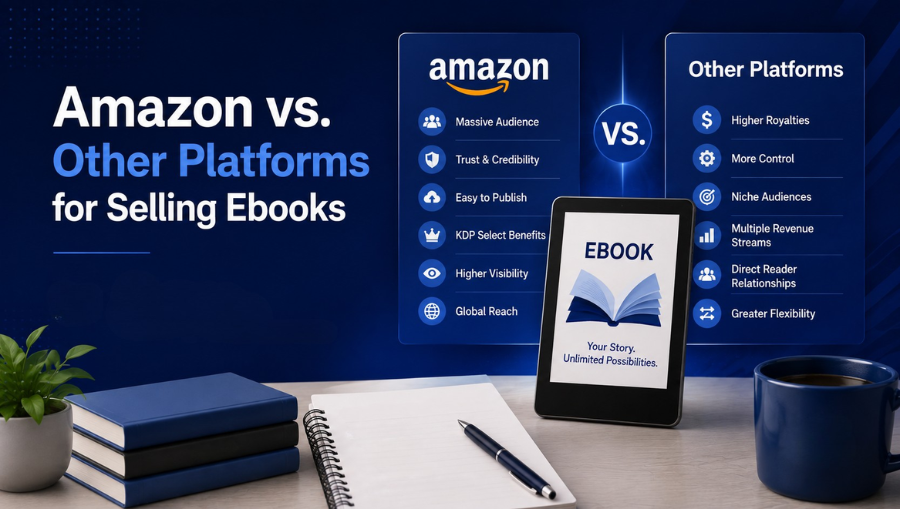
Amazon vs. Other Platforms for Selling Ebooks
Amazon offers a large audience, a familiar buying process, and simple publishing tools.
Other platforms may offer wider reach, stronger customer access, more control, or different payment terms.
The best choice begins with the reader.
Where does that person already buy books?
Which device or app does the reader use?
Does the reader shop in large stores, visit libraries, follow authors directly, or join learning groups?
The author should also compare:
- Royalty terms
- Platform fees
- Payment timing
- Customer information
- Tax support
- File delivery
- Marketing tools
- Store reach
Some writers may use Amazon for visibility and a personal website for direct sales. Others may publish widely through many ebook stores.
The best platforms to sell ebooks are the ones that match the reader’s habits and the author’s ability to manage them.
Do You Need a Publishing Company to Sell an Ebook on Amazon?
No, an author does not need a publishing company to sell an ebook on Amazon.
A writer can upload and manage the book through KDP without traditional publishing support.
However, being allowed to publish alone does not always mean doing everything alone is the best choice.
When DIY Ebook Publishing Makes Sense
DIY publishing may work well for authors who understand:
- Editing
- Cover design
- Ebook formatting
- Metadata
- KDP setup
- Marketing
- Record keeping
It may also work for a short and simple ebook with few design needs.
Some writers enjoy learning publishing tools and want full control. They can choose their own schedule and update the book quickly.
The main danger is becoming too close to the work.
Writers often know what they meant to say, so they may not notice what a new reader will find unclear. They may also miss design or formatting problems.
Even a mostly DIY project can benefit from a professional proofreader, editor, formatter, or cover designer.
When Professional Publishing Support Makes Sense
Professional support may be helpful when the book is:
- Long
- Complex
- Highly visual
- Connected to a business
- Part of a serious author career
- Planned for wide distribution
A publishing team may help with editing, proofreading, design, formatting, metadata, upload setup, and promotion.
Professional help should improve the book without removing the author’s voice.
Before choosing a company, the author should ask:
- What services are included?
- Who keeps the publishing rights?
- How are royalties paid?
- What is the full cost?
- What is the publishing schedule?
- What support is offered after launch?
Final Checklist for Selling an Ebook on Amazon
Before publishing, the author should review the final ebook file from start to finish. The title, subtitle, and author name should match on the cover, manuscript, and Amazon listing. The table of contents should work. Chapter headings should follow one style. Images and links should appear correctly. The description should clearly explain what the book offers. The keywords and categories should match the content. The price should fit the market and current KDP terms. The cover should remain clear as a small image. The opening pages should take readers into the book without a long delay. The author should also prepare a simple promotion plan.
This may include:
- Email announcements
- Social posts
- Guest articles
- Podcast interviews
- Reader outreach
- Amazon ads
- Website updates
- Future books
Publishing is not the end of the book’s life. It is the moment when the book begins meeting readers.
Frequently Asked Questions About Selling Ebooks
How Do You Sell Ebooks on Amazon?
Writers can sell ebooks on Amazon by creating a KDP account, preparing an edited book, formatting it for Kindle, designing a cover, entering the book details, choosing keywords and categories, setting a price, and submitting the ebook for review. The author should preview the file before publishing and review Amazon’s latest rules.
Can Anyone Sell Ebooks on Amazon?
Many authors, businesses, and publishers can use KDP if they meet Amazon’s account, tax, payment, identity, and content rules. The person publishing the book must own the rights or have legal permission to publish it.
Is It Free to Publish an Ebook on Amazon?
Amazon KDP generally does not charge an upfront fee just to upload an ebook. Authors may still pay for editing, proofreading, cover design, formatting, advertising, and professional publishing services.
How Much Can an Author Earn From Selling Ebooks?
Ebook income depends on the price, royalty terms, number of sales, page reads, advertising costs, and size of the author’s audience. Some authors earn little from one book. Others build higher income through several books, a series, direct sales, or related services.
What Is the Best Price for an Amazon Ebook?
There is no single best price for every ebook. The author should compare similar books, think about the length and value, and review Amazon’s current royalty rules. The price should feel fair to the reader and support the author’s long-term plan.
How Long Does It Take for an Ebook to Appear on Amazon?
Publication times can vary because Amazon reviews books before making them live. Authors should upload early enough to allow time for review, corrections, and possible delays.
Do You Need an ISBN for a Kindle Ebook?
Amazon has not always required authors to provide their own ISBN for Kindle ebooks. However, platform rules can change. Authors should check the latest KDP guidance before publishing.
Can You Update an Ebook After Publication?
Many parts of an ebook can be updated after publication. These may include the manuscript file, cover, description, keywords, categories, and price. Some changes may need a new review. Major changes to the title or author name may also require extra steps.
Can You Sell the Same Ebook on Amazon and Other Platforms?
In many cases, yes! However, ebooks enrolled in certain exclusive Amazon programs may not be allowed on other stores during the enrollment period. Authors should read the current terms before joining an exclusive program.
Is Amazon the Best Place to Sell Ebooks?
Amazon may be the best place to sell ebooks for writers who want access to a large Kindle audience and a simple sales system. It may not be the only best platform for every author. Other ebook stores, direct-sales services, libraries, course platforms, and personal websites may offer added reach.
How Can New Authors Get Their First Ebook Sales?
New authors can begin with a professional cover, clear description, fair price, strong sample, honest reviews, and focused promotion. They can also contact people who may truly enjoy the book, build an email list, write useful articles, and share the book in suitable reader groups. The first sales often come from trust, not fame.
Do Amazon Ads Promise Ebook Sales?
No. Amazon ads may help more shoppers see the book, but they do not promise that people will buy it. The cover, title, description, price, reviews, and sample still affect the final choice.
Can You Sell a Short Ebook on Amazon?
Yes, a short ebook may be sold if it offers real value and follows Amazon’s current content rules. The length should match the promise. A short guide can work well when it solves one clear problem. The description should honestly tell readers what they are buying.
What Kinds of Ebooks Sell Well Online?
Ebooks often sell when they meet a clear reader need. This may include entertainment, useful lessons, emotional comfort, professional knowledge, personal growth, or help with a specific problem. A popular topic may bring attention, but the book still needs quality, clear positioning, and good presentation.
Should an Author Publish One Ebook or a Series?
A single ebook can succeed when it offers a focused and useful reading experience. A series may create more long-term sales because readers who enjoy one book may buy the next. The content should decide the format. Authors should not stretch one idea across several weak ebooks just to create a series.
What Is the Best Way to Start Selling Ebooks Online?
The best starting point is a finished and edited book written for a clear reader. The author can then choose the best platform to sell ebooks, prepare a professional cover, format the file, write honest metadata, set a fair price, and create a simple promotion plan. A finished ebook begins as a quiet file on a computer. Publishing opens the door, but careful preparation helps the right reader walk through it. Authors who need support with editing, cover design, ebook formatting, publishing, and distribution can explore the affordable book publishing solutions offered by Blue Mount Publisher. The goal is not only to place a book online. It is to prepare the book so well that readers feel confident choosing it.